Journal home / All articles / Aftercare and the envelope
Gutters, valleys and flashings after the coating
The membrane is the part of a restoration you can see from the street. Water leaves the house through the parts a cheap quote hoped you would not look at.
Tom Birtles · 11 August 2025 · Updated 21 August 2026
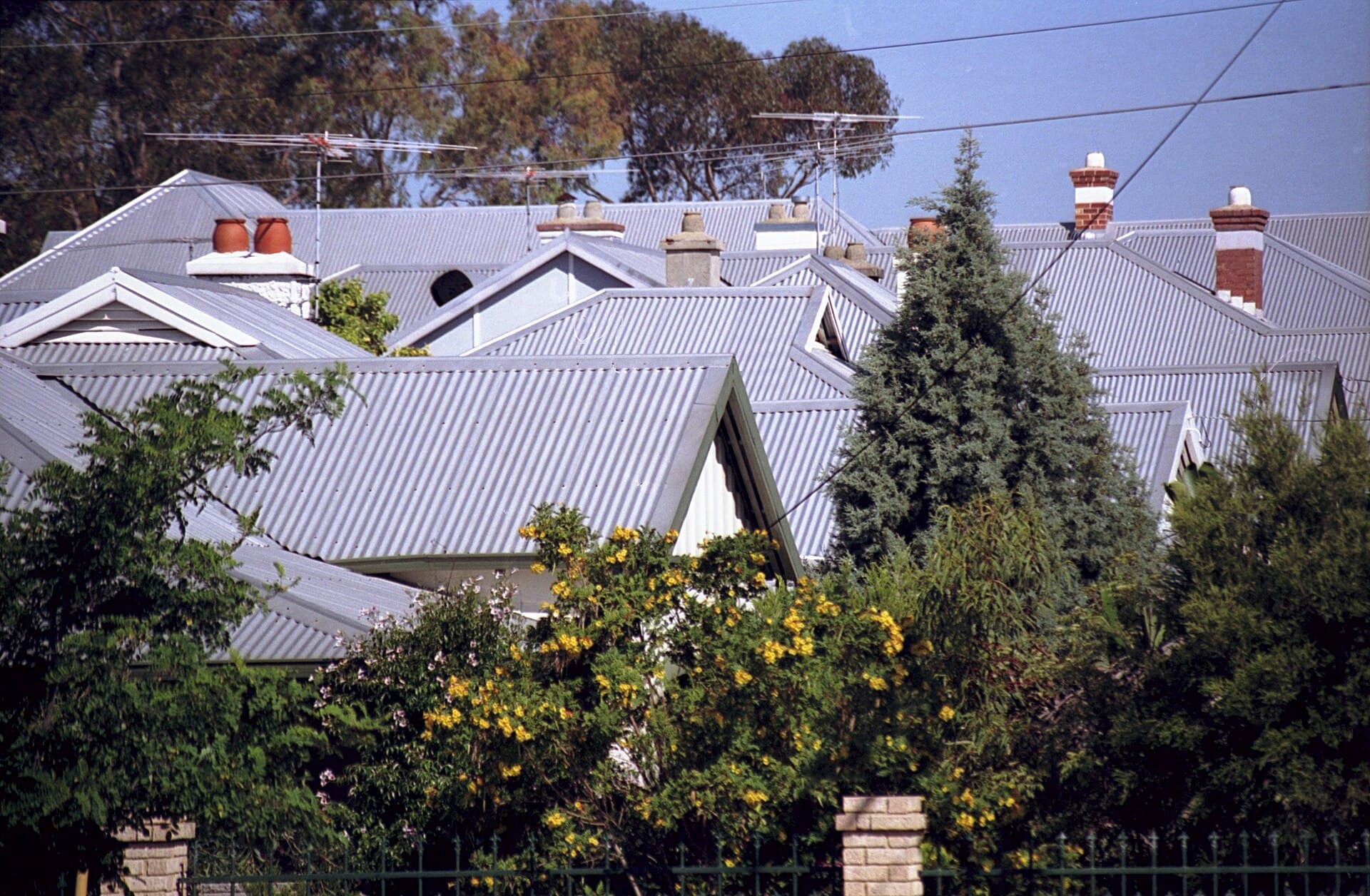
Corrugated galvanised iron roofs in Mount Lawley, Western Australia. Photograph: Greg O'Beirne. CC BY 2.5. Source: Wikimedia Commons. See the image credits page.
A restoration photograph is almost always taken looking up the field of the roof. The tiles or the pans look even. The ridge looks freshly pointed. The colour is the colour that was sold on the verandah. What the photograph does not show, because it is not flattering and because it is where the water actually goes, is the gutter bed, the valley iron, the apron at the wall, and the little metal skirts around pipes and solar cables. Those are the roof’s plumbing. A membrane is not a substitute for them. It is, at best, a coat on the surfaces that shed toward them.
Brisbane crews have always known this. The competent ones price valleys and flashings as themselves. The others treat them as a sentence in the exclusions, or as a place to run the spray gun until the iron looks as new as the tiles. Then the first storm arrives, and the house discovers that paint is not thickness. The old family sites used to list rusty valleys in the same breath as broken tiles. That pairing was accurate. It still is. If you want the whole sequence of a proper job, start with the anatomy of a Brisbane roof restoration. This page is about what to look for after the trailer has gone, when the coating has become the least interesting surface on the roof.
Overpaint in the gutters
Acrylic in a gutter is a common leftover. Some of it is overspray. Some of it is a crew using the gutter as a place to unload a gun at the end of a pass. On a metal gutter the film can sit, trap silt, and keep moisture against a surface that was already thin. On an older galvanised gutter the combination of trapped mulch and a skin of paint is a rust argument with a delayed fuse.
Look from a ladder, on a dry day, without standing in the gutter. You want to see outlets that are open, a fall that still goes toward the downpipe, and no ponds of rubbery acrylic at the corners. You want to see that the overflow paths — rainheads, weirs, the little gaps that save a fascia in a January cell — have not been sealed by enthusiasm. If the crew also high-pressure cleaned the driveway, as the old combined offers often did, check that the same rinse that left the path handsome did not wash grit back into the outlets.
A light mist can be cleaned. A thick, continuous skin should be removed by the people who put it there, not by a homeowner with a hook and a Saturday. Call the contractor with a photograph. Owner-operators who still answer the phone will come and recut. Canvassers will tell you it is “just paint” and that it will break down. Paint that blocks an outlet does not need to break down. It needs to be gone before the next cell.
Fascia and barge suffer next. Water that cannot leave a gutter leaves over the front edge, blackens the timber, and feeds mould on the path. The envelope is one drainage story. A newly coated roof above a stained fascia is not a finished house. It is a roof that has started to use the wall as a downpipe.
Valleys that were skipped, painted, or wished away
Valleys are where two roof planes agree to send all their water down a narrow tray. In SEQ that tray works hard. It takes leaf litter from figs and jacarandas, grit from tiles, and the sudden volume of a subtropical downpour. Older valley iron in inner Brisbane is often original, thin, and already holed at the fastenings or at the splash points. Restoration does not magically thicken it.
A cheap quote has three bad habits with valleys. It excludes them in a footnote. It “seals” them with a brushable membrane that looks wet and impressive and then splits at the movement line. Or it spray-coats them the same colour as the tiles so that, from the street, the rust no longer shows. All three habits survive the after photograph. None of them survives a proper storm.
If you have a leak after coating, look at the valley before you look at the membrane. The tracing essay — leak tracing when the new membrane still weeps — starts from that suspicion. From the ground you may see rust streaks on the new film, a brown line on the ceiling that follows the valley, or a stain at the gutter stop-end where the valley discharges. From a licensed inspection you may see pinholes, a tray that no longer sits under the tiles, or a repair that stops a metre short of the ridge.
Metal roofs have their own valley and lap issues, and a coating on corrugated iron is a different chemistry conversation. Colorbond and corrugated metal restoration is the materials page. The aftercare point is the same. If the restoration did not replace or properly treat the tray, the coating on the field is cosmetics.
Ask, if you are still at quote stage, for the valley to be named: replace, repair, or exclude. After the job, ask for photographs of the trays before they were covered. A contractor who will not photograph a valley is a contractor who does not want you to remember it.
Apron flashings at walls, and the joins a Queenslander invents
Brisbane houses grow. A kitchen skillion is added. A second storey is tucked over the rear. A verandah is enclosed. Each of those decisions creates an apron, a soaker, or a messy marriage between a wall and a roof plane. Water hits the wall and is supposed to be caught and returned to the roof. If the flashing is short, rusted, or buried in a later render, the water goes behind the cladding instead.
Coating the tiles up to a wall does not create a flashing. It can, if the spray is enthusiastic, hide the fact that the flashing is already failing. It can also bridge a gap that was allowing a little ventilation and a little movement, then crack at the first hot week. Look at wall-to-roof junctions after the first heat and the first storm. Look at the ceiling on the room side. Look at the top of the kitchen window that sits under a later skillion. These are not membrane problems until someone has already refused to call them flashing problems.
Chimneys and flues are a specialised version of the same join. So are the older whirlybird penetrations and the newer exhausts. A restoration that recoats around them without lifting and resetting the flashing is hoping the existing metal has years left. Sometimes it does. Sometimes the first weep is in month two.
Two-storey Queenslanders make all of this harder to see and more expensive to do. Access at a wall junction is still working at heights. Temporary rails and harnesses are not optional because the task is “just a flashing”. Roof plumbing is its own QBCC class for a reason. A painting licence that covered the membrane does not automatically cover the tray.
Solar penetrations, screws and the later hole
Solar has changed the aftercare of Brisbane roofs more than any coating system. Frames sit on tiles or clamp to ribs. Cables go through. Installers walk the new film. A restoration completed in August can be punctured in November by a crew that has never read the warranty conditions and does not care to.
After coating, treat every penetration as a named object. Where does the cable enter? What flashing or gland was used? Did anyone coat over a mastic instead of installing a proper roofing penetration? Are there screws in a valley, because that was the easy line? Metal roofs, especially, collect later screws the way older houses collect later decisions.
If you already have solar, the restoration quote should have said what would happen at those points. If solar came after, the solar quote should have said how the film would be protected and how broken tiles would be replaced. Your labelled, coated spares exist for this. A hardware-store tile on a coated roof is a permanent patch. A hardware-store silicone on a coated valley is a temporary leak.
Antennae, air-conditioning units on stands, and the occasional leftover dish are the same family. After a restoration, walk the list of things that pierce or sit on the roof and ask whether they were isolated, reset, or ignored. Ignored is the usual answer. Write it down so that the next stain has a cause.
A short inspection list you can run from the ground
You do not need to become a roof plumber. You need a habit of looking at the parts the photograph omitted.
- Gutters: open outlets, no ponds of acrylic, fall still visible, overflow paths not sealed, fascia not newly blackened.
- Valleys: rust streaks on new coating, discharge points at the gutter, any obvious patching or colour that does not match the tray.
- Aprons and walls: staining under junctions, cracked bridging, render that has been painted over a missing soaker.
- Penetrations: solar, flues, exhausts, screws that sit in water paths.
- Driveway and paths: fresh rust flakes, tile chips, or a waterfall stain that shows where a gutter is dumping.
If something is wrong, call the original crew first, with photographs, while the job is still young. If the original crew was a canvasser’s pipeline, you may be calling a number that rings through to a new voice. That is why the licence search and the legal name mattered in winter.
Asbestos sits at the edges of this work. Old eaves linings, some barge details, and fibre-cement sheets near flashings are still stop-and-test material. A gutter recut that turns into a grind along an unknown soffit is no longer a tidy aftercare task. Neither is a high-pressure rinse aimed at a painted sheet because the driveway clean went well.
Water is not impressed by colour. It takes the valley, the apron, the screw and the blocked outlet.
After the coating, those are the parts of the house that deserve the attention the membrane already had. Look there first. The tiles will still be the colour you chose. The ceiling will tell you whether that was enough.
Questions from the verandah
- Is coating in the gutters a defect?
- Overpaint that blocks outlets, sits in ponds, or seals debris against the metal is a defect. A light mist that can be cleaned out is sloppiness. Either way it is easier to fix in week one than in year three, when the gutter has rusted from the inside around a skin of acrylic.
- Why do valleys leak after a “full restoration”?
- Because the valley was often excluded, painted, or patched rather than replaced. A membrane on the tiles does not become a new steel tray. Water still concentrates in the valley, and rusted iron still holes.
- Who is responsible for solar penetrations?
- Whoever made the hole, unless your restoration quote explicitly reworked those flashings. After coating, a solar screw through a valley or an unsealed roofing screw is a later-trade problem that will still wet your ceiling.
- Can I just recut the gutters myself?
- You can clear debris from the ground with care. Recutting, replacing, or working at the eaves of a two-storey house is still roof plumbing and still a heights job. Hire the class, not the weekend.