Journal home / All articles / Tile, tin and mixed roofs
Colorbond and corrugated metal restoration
Cut-edge rust, tired screws and abused silicone are the real metal-roof conversation in Brisbane. A respray can be cosmetics. A sheet that has gone at the lap needs replacing, not another film.
Patrick O'Shea · 7 July 2025 · Updated 15 August 2026
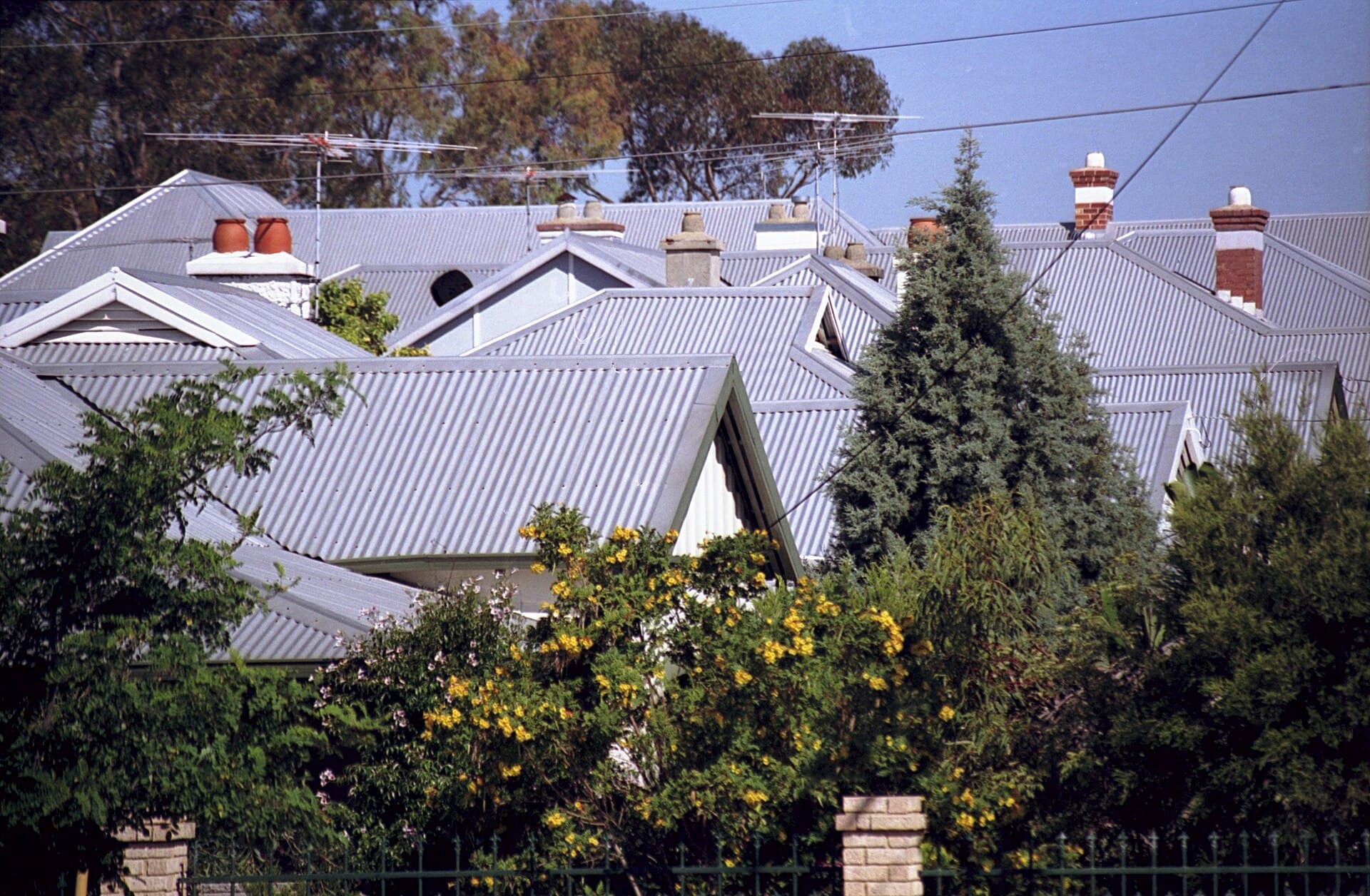
Corrugated galvanised iron roofs in Mount Lawley, Western Australia. Photograph: Greg O'Beirne. CC BY 2.5. Source: Wikimedia Commons. See the image credits page.
Metal roofs in this city are a family argument that gets flattened into one word. Colorbond, Zincalume, old galvanised corrugated iron, a tray here, a custom orb there, a patio sheet that was never meant to be the main roof. Restoration language borrowed from tiles — wash, prime, two coats — lands on these roofs as if they were just another substrate. They are not. They fail at edges, fasteners and laps. They are repaired with metal, or they are painted so the rust is a nicer colour.
The old contractor pages listed metal and slate alongside concrete and terracotta because crews were asked to look at whatever was on the house. That was honest about the work and loose about the specification. A tile membrane on rusty corrugated iron is a category error. So is a quote that treats a 2010 Colorbond hip in Karalee as if it were a 1960s tin verandah in Corinda.
This essay is about the failures that actually show up on Brisbane metal, the point at which a respray is cosmetics, and the point at which the sheet has to come off. Subtropical storms will keep testing both decisions. The climate does not care whether the colour is still under warranty in a brochure sense. It cares whether water can get under a lap.
What the sheet is, and what was cut
Factory-finished steel — the products people mean when they say Colorbond — is a stack of layers: steel, metallic coating, primers, a baked colour. The stack is good at being a sheet. It is less good at being a cut. Every end, every penetration, every hole for a screw is a place the stack was opened. Those places rust first. In a gutter line, under a leaf dam, on a low-pitch patio that never quite dried after a January storm, the cut edge is a small brown fact.
Older galvanised corrugated iron is a simpler stack and a longer story. It can last in this climate if it was heavy enough and if nobody trapped water against it. It can also be a lace of rust that still looks, from the street in Geebung, like a roof. Walking it is a judgement. So is painting it. A film on lace is a film on air.
Zincalume and its cousins have their own manners, including a dislike of being mixed carelessly with other metals and a surface that needs the right preparation if you insist on painting it. The brand names change. The principle does not: know what you are standing on before you name a system.
Screws, washers and the hole you paid for
A corrugated or ribbed sheet is held on with fasteners. Each fastener is a hole you have accepted. The washer under the head is the difference between a hole and a leak. UV kills washers. Over-tightening kills washers. Under-tightening leaves a gap. A restoration that does not talk about screws is a restoration of the colour, not of the water path.
On older roofs the screws may be a mixed museum: galvanised, a later stainless, a roofing screw meant for a different profile, a few tek screws from a skylight installer. Dissimilar metals and tired washers are how a “solid tin roof” in Birkdale starts staining a ceiling in a neat grid. The grid is the clue. Tiles leak in organic shapes. Fasteners leak like a plan.
Re-screwing is unglamorous and often the highest-value work on an otherwise sound metal roof. Right screw, right washer, right seat in the rib, not the pan, unless the profile says otherwise. Do not bury a tired washer in silicone and call it a system. The silicone will let go. The hole will remain.
Laps, capillary and the storm that sits
Sheets lap. Water is supposed to run over the lap, not into it. On a decent pitch, with a decent overlap, it usually does. On a low patio pitch in Sunnybank Hills, or a long run that has oil-canned and ponded, capillary and wind-driven rain take water sideways and uphill. Storms in this climate do not always arrive as a polite vertical. They arrive as a hose from the north.
Rust at a lap is more serious than rust at a free edge. The lap is a joint. Once the metal there has thinned, you do not have a stain. You have a seam that can open. Paint will not recreate a thickness. A patch might buy a season. Replacement of the sheet, or of the run, is the sentence that matches the defect.
End laps — where one sheet finishes and the next begins down the slope — are frequent offenders on longer planes. Side laps, if they were shorted to save a sheet, are the rest. An inspector should look, not assume the original installer was generous.
Silicone abuse
There is a particular aesthetic on tired metal in this city: grey sausages along every lap, around every screw, at the base of every penetration. Someone meant well, or someone meant to finish by Friday. Silicone, used as a primary weatherproofing on a roof sheet, is a delay with a smell.
It fails in the sun. It fails where the sheet moves. It fails where someone painted over it and the paint could not stick. It holds moisture against a cut edge and hurries the rust it was meant to stop. A restoration that begins with a day of peeling silicone is already telling the truth. A restoration that adds a fresh sausage to the museum is continuing a myth.
Legitimate sealant use exists: a specified joint, a compatible product, a flashing detail that was designed for it. That is not the same as caulking a roof until it looks like a plumbing emergency. If the sheet needs that much product, the sheet needs to be replaced, or the flashing needs to be remade in metal.
A roof that depends on silicone is a roof that is already arguing with its own design. Paint will not win that argument. Metalwork might.
When a respray is cosmetics
Sometimes cosmetics are what was wanted. A faded Colorbond roof on a sound house in Ascot, screws recently done, laps tight, cut edges treated, no holes you cannot account for: a specialised metal-roof coating system, prepared and applied as the sheet describes, can refresh colour and add a measure of protection. It will not make the roof new. It will make it look attended to. That can be a reasonable purchase.
It is cosmetics when the owner thinks they have bought the equivalent of a tile restoration's extra decade. Metal does not work that way. The sheet's life is about remaining thickness and remaining fasteners. A film does not replace steel. If the quote implies otherwise, the quote is a tile speech wearing a tin hat.
Preparation on metal is not a tile wash. Oils, mill dust, oxidation, the particular way a factory finish weathers: the product sheet is picky because adhesion on a slick, weathered surface is picky. Skip the prep and the new colour leaves in sheets, which is a very visible way to learn about surface energy.
When the sheet must be replaced
Replace when you can put a tool through the lap. Replace when a boot writes a dent that stays as a crease in a pan that already ponds. Replace when rust has opened a screw hole into a slot. Replace when the corrugations have rusted through on the hidden side and the street face is still performing. Replace when the roof is a patchwork of silicone and short sheets that no longer make a plane.
Partial replacement is normal. A western pitch that took the weather, a valley adjacent that was buried in leaves, a verandah roof that was a thinner grade than the main house — these can come off without a full strip. Mixing new factory-finished sheets with old ones is a colour problem and sometimes a metal-compatibility problem. Detail it. Do not hope.
Full replacement versus restoration is the money essay. On metal the technical trigger is easier to name than on tiles: remaining steel, or not. If you are arguing about remaining steel, you are already past cosmetics.
Asbestos caution still belongs on some older metal roofs, not because the sheet is clay, but because older underlays, backing and compounds can sit in the suspect class. Identification before grinding or aggressive abrasion is the same rule as on tiles, in a different accent.
Flashings, gutters and the rest of the envelope
A metal roof is a system of edges. Ridges, barges, aprons, gutters, valleys: the water is always being asked to change direction. Tired flashings are as common a leak as tired sheets. A restoration that coats the field and leaves a short apron against a wall in New Farm has restored the photograph.
Gutters on metal houses in Cleveland and Redcliffe take the same leaf load as anywhere and a bit more wind-driven rain. Overflowing gutters put water back under an edge that was only just coping. Gutters, valleys and flashings after a coating is the aftercare version. The during-care version is: fix the edges, then talk about colour.
Dissimilar metals at a gutter or a flashing will produce the slow brown stain that owners attribute to the roof sheets. Sometimes it is the roof sheets. Sometimes it is a copper stain, or a reaction at a junction that should have been isolated. Look before you spray.
Solar, penetrations and the new holes
Solar on metal is easier than solar on old terracotta and still not free. Every stanchion is a penetration. Every poorly flashed cable is a path. Walking an array to wash or coat is a scratch-and-dent business on a factory finish. If the restoration cannot work around the rails, say so. Do not grind rust next to a cable and call it maintenance.
Skylights, whirlies, the bathroom fan that was cut in with optimism: these are where silicone museums begin. Remake the flashing in metal if you can. If you cannot, at least stop adding product to a joint that has already told you it does not want to be a joint.
A metal job, named as a metal job
Ask what the sheet is. Ask about screws as a line item. Ask what will be done at cut edges and laps. Ask where silicone will be removed, and where it will be used, if at all. Ask which sheets are being replaced, and which are only being coloured. Ask how the coating, if there is one, is prepared for this finish, not for a tile.
High-set tin in Corinda and a low-set Colorbond in Regents Park should not share a specification just because both are “metal.” The first may be a lace and a carpenter. The second may be a fastener afternoon and a colour decision. Brisbane has both, often on the same street as a concrete-tile veneer, which is why a journal has to keep the materials from collapsing into a single flyer.
The honest metal restoration is mostly not a coating. It is fasteners, edges, laps and the courage to replace a sheet that has already become a hole. The coating, when it comes, is the last and smallest sentence — or it is cosmetics, which is allowed, if everyone uses that word.
Questions from the verandah
- Can you restore Colorbond the same way you restore tiles?
- No. The chemistry, the failures and the honest end of life are different. Metal wants cut-edge treatment, fasteners and laps, not a tile membrane and a ridge rebed.
- When is a respray just cosmetics?
- When the sheets are sound, the screws are sound, and you are buying colour or a measure of UV refresh. If rust has opened a lap or a pan, paint is a delay.
- Why do cut edges rust first?
- Because that is where the protective layers were severed, and where water sits. Brisbane humidity and leaf litter make those edges a small, reliable laboratory.
- Is silicone a legitimate metal-roof repair?
- As a temporary courtesy, sometimes. As a substitute for a fastener, a lap or a flashing, no. Dried sausages of silicone are how the last leak was hidden, not how it was fixed.