Journal home / All articles / Money and decisions
Insurance, storm claims and restoration
After a Brisbane storm, restoration sits in an awkward place between like-for-like, betterment and a cash settlement. Insurers have reasons to prefer replacement. Owners have reasons to ask for the scope in writing.
Patrick O'Shea · 28 April 2025 · Updated 6 August 2026
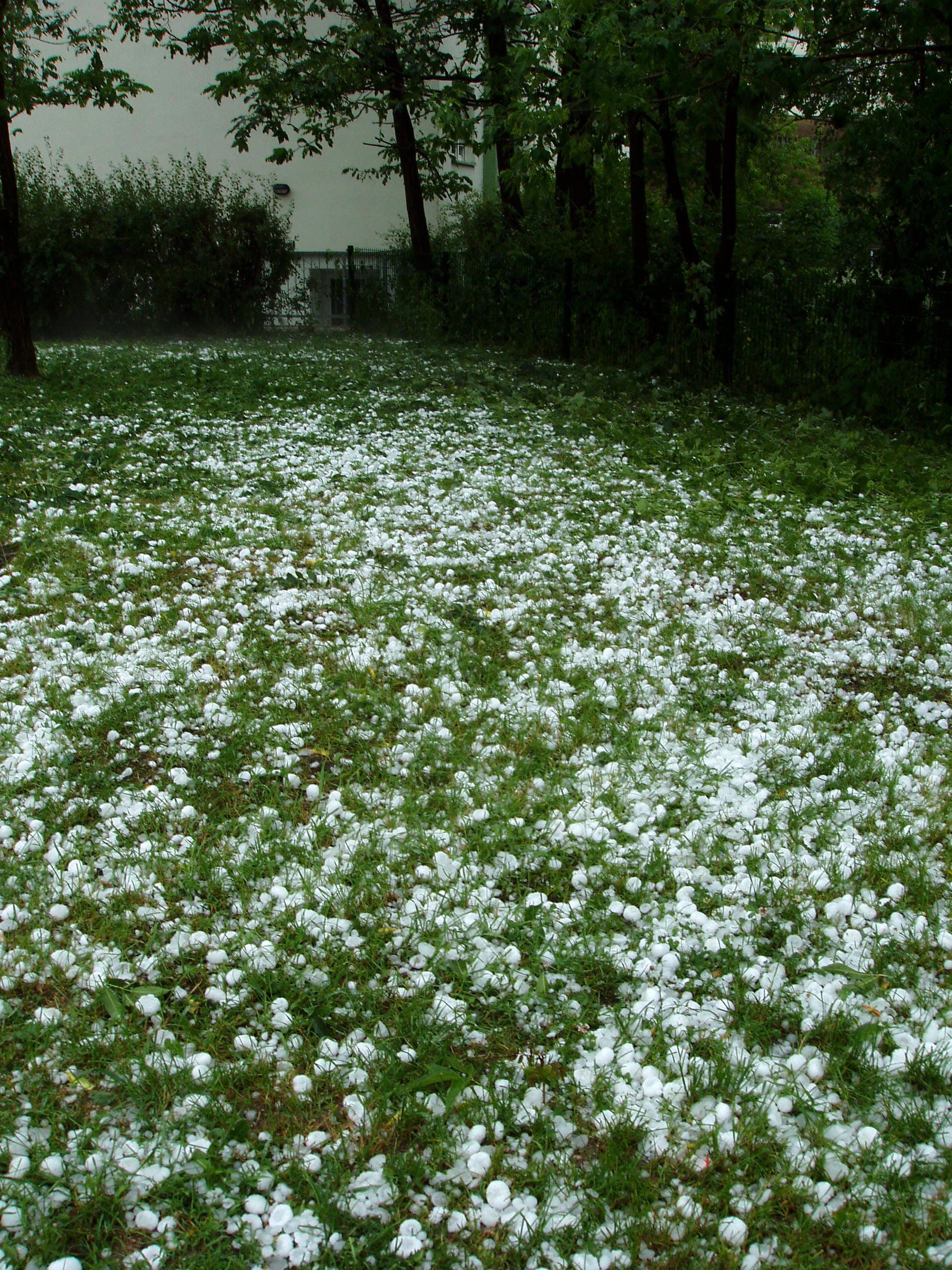
Ground covered in hail after a severe storm. Photograph: Nerdybeng. Public domain. Source: Wikimedia Commons. See the image credits page.
The morning after a cell has moved on to the Gold Coast, Brisbane households split into two climates. One is the physical roof: wet plaster, grit in the gutter, a ridge cap on the lawn. The other is the policy. Those climates share a vocabulary — storm, damage, repair — and almost nothing else. Restoration lives in the gap. It is sometimes the right building job and the wrong insurance job, or the reverse, and the argument that follows is older than any particular coating brand.
This is not a guide to winning a claim. It is a guide to understanding why the fight has the shape it has: like-for-like against betterment, cash against rebuild, restoration against replacement. The physical morning is described in hail, wind and the morning after. The building choice, once money is not pretending to be a specification, is in restoration versus full replacement. The paper you will be handed by trades is in how to read a roof restoration quote. What follows is the file that sits between them.
Like-for-like is a stricter idea than it sounds
A typical domestic policy, in the broad and non-legal sense that journalism can use, undertakes to put you back to where you were before the insured event, not to the roof you now wish you had. Like-for-like on a 1984 concrete tile roof in Algester is tiles of that kind, or a modern equivalent if the old ones are gone, with the same function. It is not, automatically, a membrane system in a cool grey with a brochure warranty.
This is where restoration first becomes awkward. A competent restoration after hail may include cleaning, replacing a run of broken tiles, rebedding ridges, renewing valleys, and coating the lot so the wounded faces do not become a moss farm. Some of that is repair of storm damage. Some of it is the maintenance you had been postponing since the last wet season. Insurers are not always wrong when they draw that line. They are sometimes wrong about where the line sits.
If the storm cracked fifty tiles and washed out pointing that was already exhausted, the pointing is still part of the envelope that failed in the event. If the storm cracked five tiles and the restorer wants to coat eight squares because the colour will “even it up”, you are now in betterment country, even if the colour would be wise.
Like-for-like on metal is no simpler. Dents that do not leak are still a change in the thing you insured. Whether the policy treats cosmetic denting as payable is a matter of wording and of the assessor’s day. Replacement of a whole steel roof because the western pitch looks like a golf ball is a large like-for-like claim. Coating the dents is a small restoration that may not satisfy anyone: not the owner who still sees dimples, not the insurer who sees a betterment request, not the next buyer who sees a painted roof and wonders what it is hiding.
Write down, in ordinary sentences, what the storm did. Not what the house needed. The claim is about the event. The restoration quote may be about the house. Those documents should talk to each other. They should not be the same document.
Betterment, and the fear of a nicer roof
Betterment is the insurer’s word for the part of the job that leaves you ahead. A new colour, a cooler pigment, a thicker system, a change from tired concrete to Colorbond, solar flashings that were never any good, insulation you did not have. Some betterment is accidental: you cannot buy 1984 tiles, so you buy 2026 tiles and the roof is, in some sense, newer. Some is a choice.
Restoration attracts the betterment argument because it looks like an upgrade even when it is a repair. A membrane changes the appearance of the whole roof. Neighbours notice. Photographs look like a renovation. An assessor who has been burnt by owners using a claim to fund a streetscape project will see a spray gun and think betterment. An owner who has been burnt by an assessor refusing to pay for the pointing the hail actually destroyed will see a spray gun and think survival.
The way through is a scoped list, not a feeling.
- Storm-broken units, named and counted.
- Storm-shifted or storm-opened ridges and hips.
- Valleys and flashings opened or punctured by the event.
- Making-safe and tarps.
- Cleaning that is required to inspect or to repair, not cleaning that is required to sell a colour.
- Coatings only where they are the repair of a damaged surface, or where the parties agree they are a cash-settled extra.
If you want the cool-roof tint because January in the upstairs room is a health complaint, that is a household decision. It may be good building. It may not be the insurer’s building. Paying the difference yourself is not a moral failure. Calling the difference “storm damage” is how files stall.
Why replacement can look cheaper to an insurer
Replacement has a clean story. One trade, one product, a new start, a warranty from a manufacturer of sheets or tiles rather than a film. The next storm hits a known object. The assessor can price a square. The claims manager can close a line.
Restoration has a messy story. Remaining life of the tile. Bond of a coating to a bruised face. Whether the sarking was already rags. Whether the next cell will find a path that was never in the scope. Whether the owner will claim again in fourteen months and say the first repair was incomplete. From a desk in an office that is not in the wet ceiling, replacement can look like the less expensive argument even when the invoice is larger.
Sometimes they are right on the building too. A concrete tile roof that has lost its face, grown a habitat of lichen, and taken hail on already tired pans may not have a restoration life that is worth anyone’s money. A steel roof with rust at the laps and denting across two pitches may be a candidate for sheets, not for a tint. The journal’s other essays will keep saying this: restoration is a job for a roof that is still a roof.
Sometimes they are wrong, and the preference for replacement is a preference for a file that does not require a coatings argument. You are allowed to ask for the cheaper sound repair if the cheaper sound repair exists. You are allowed to say no to a replacement that is being used to close a claim you did not want closed that way, especially if the streetscape or the heritage roof is the point of the house. You will need your own independent scope for that conversation. The insurer’s preferred contractor is not your only reader.
Cash settlements and the job of becoming the client
A cash settlement is a number in place of a repair. It can be the right freedom: you choose the contractor, you choose restoration or replacement, you choose the colour, you wait for the dry season. It can be the wrong freedom: the number was built from a light scope, GST was a surprise, the solar lift was not in it, and you are now the project manager of a heights trade you do not practise.
Before you accept cash, rebuild the job on paper as if you were the insurer. Height, access, tile count, valleys, waste, solar, interior damage, temporary living if the ceiling is open. Then add a weather contingency if the money will be spent in the wet months. Then ask whether the number still looks like a roof.
Cash also changes the warranty map. The insurer is no longer running the repair. The contractor’s workmanship and the manufacturer’s product sit with you. That can be fine. It is not the same as a repair the insurer directed and, in some cases, has a different obligation to complete.
Do not let cash be a way of not photographing. The settlement is still attached to an event. If the number is later disputed, or if a second cell arrives before the work, the morning-after pictures remain the spine of the file.
Scope fights, and how to keep them about sentences
The worst claims are not the ones with the biggest stones. They are the ones where everyone is talking about a different roof. The owner is talking about the roof they will have to live under in February. The restorer is talking about a system they know how to apply. The assessor is talking about a policy event in November. The interior decorator, if the household has one, is talking about the grey they saw in a magazine.
Bring the talk back to sentences that can be ticked.
- This tile is cracked through. Here is the photograph.
- This ridge joint is open. It was closed in the pre-storm pictures, or it was not, and we will say which.
- This valley is holed. Replacement is the repair of the hole.
- This colour coat is a choice. Here is the price difference.
- This interior stain appeared during the event. Here is the date.
If a restorer offers to “handle the claim” as part of the quote, slow down. Some are experienced and careful. Some are selling a coating with an insurance story attached. You can authorise someone to talk. You should still know what they are saying is the scope. A signed authority is not a signed confession that the roof was fine in October.
Assessors are not villains by profession. They are people with a lot of roofs and a language that has to survive a review. Give them the event, not the life story of the house. Save the life story for the restoration decision you will make with your own money if the policy will not follow you there.
After the file, the weather continues
A settled claim is not a settled climate. The next shelf cloud does not read the release. If the work was restoration, live the first year as if the film were new and the gutters were part of the warranty. If the work was replacement, the new roof still has flashings, solar holes and a western pitch that will cook. If the work was cash and you have not yet spent it, the tarp is still not a roof.
Keep the file. Policies, scopes, photographs, batch numbers if a coating was part of the repair, the name of the assessor, the date of the cell. Brisbane will offer you another afternoon. The households that suffer least the second time are not the luckiest. They are the ones who treated the first claim as a record of a particular storm on a particular roof, not as a general complaint about living in the subtropics.
Like-for-like will always be narrower than hope. Betterment will always be the argument about hope.
Replacement will always look tidy from a desk. Restoration will always look like a judgement. Make the judgement in daylight, with the photographs still on the phone, and with a quote that can be read as a specification. The policy will do what the policy does. The roof, after that, is yours again.
Questions from the verandah
- Why might an insurer prefer to replace a roof rather than restore it?
- Replacement is a cleaner like-for-like story, with a new product life and fewer arguments about coatings, remaining tile strength and whether a membrane is betterment. Restoration can be cheaper, but it is also a scope fight waiting for the next cell.
- What is betterment in a roof claim?
- Betterment is the part of a repair that makes the roof better than it was, beyond returning it to its pre-storm condition. A full colour membrane on a roof that only lost pointing in the hail can be treated as betterment, even if it is good building practice.
- Should I accept a cash settlement?
- Only after you understand what it will and will not buy, including GST, the real scope, and the fact that you become the project manager. Cash can be freedom. It can also be a short number against a long roof.