Journal home / All articles / Money and decisions
Body corporate and shared roofs
Townhouses and units in Brisbane share more than a colour. They share common property, access through lots, and an AGM that can turn a membrane into a debate about ten opinions.
Lila Nguyen · 14 July 2025 · Updated 12 August 2026
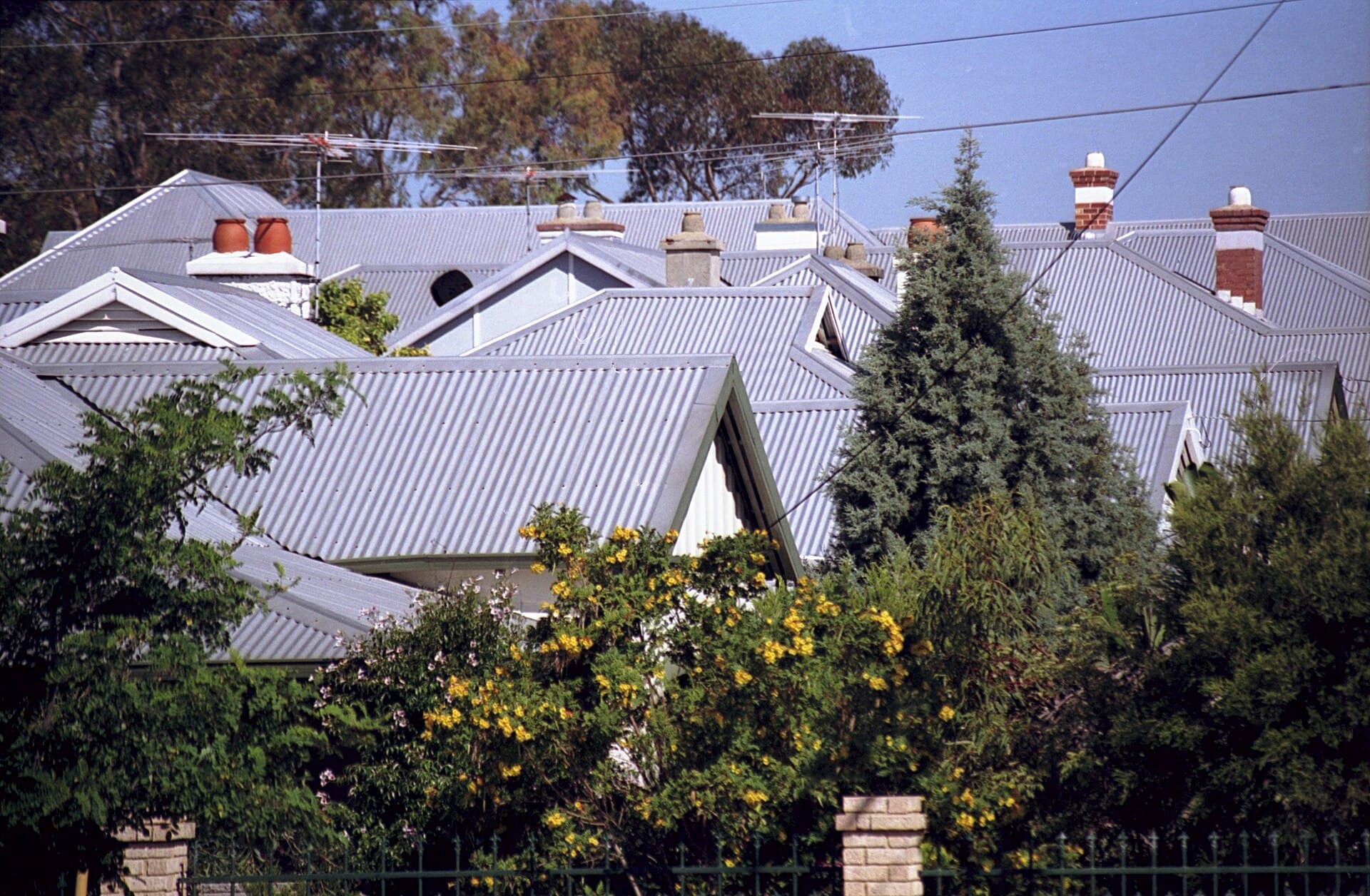
Corrugated galvanised iron roofs in Mount Lawley, Western Australia. Photograph: Greg O'Beirne. CC BY 2.5. Source: Wikimedia Commons. See the image credits page.
A shared roof is a political object that happens to shed water. In a townhouse court in Carindale, a 1990s unit block in Toowong, a row of six in Nundah, or a mixed development off a new road in Springfield, the tin or the tile does not care who paid the levy. It cares about valleys that serve two lots, a parapet that serves six, and a colour that must survive an annual general meeting.
Body corporate work is where restoration either becomes a proper project or becomes a rumour. The rumour version is a canvasser at one door, a special levy that surprises the owner who was interstate, a colour that looked different on lot twelve, and a leak in lot three that everyone agrees is “the body corp” until the first invoice for extras. The project version is slower and less photogenic. It is also the only version that still looks like a roof after the first wet season.
This is a decisions essay, not a strata-law manual. Schemes differ. Titles differ. The community titles legislation will beat a journal every time. What can be said from the roof is how the work actually fails or holds when many households share one envelope. Read it beside how to read a roof restoration quote and choosing a contractor without a sales pitch. The water that leaves the shared surface has its own afterlife in gutters, valleys and flashings after coating.
Common property, and the leak that lives in a bedroom
The first task is to know what the scheme actually is. In many townhouse complexes the roof is common property even when the ceiling under it belongs to a lot. In some older arrangements the lines are stranger: a courtyard roof here, a carport there, a terrace that was enclosed in 2004 and never quite added to the plan. Assumptions are how people end up paying privately for a common valley, or waiting for a committee while their own plaster swells.
If you are an owner with a stain, you are still allowed to photograph, tarp from the inside, and write to the committee as if they were a client — because in a sense they are. If you are on the committee, you are allowed to treat that letter as a defect in an asset, not as a personality. The climate does not care about the last AGM’s tone.
Shared roofs hide shared paths. A valley between lot five and lot six will wet whichever ceiling is downhill of the rust. A parapet scupper that blocks in a February cell will choose a unit by gravity, not by levy history. Restoration scopes that treat each hip as a separate house will miss the thing that actually fails: the junction.
Parking structures, walkways and the metal lids of bin rooms are part of the same weather. They are often left off the pretty quote because they are not in the street photograph. They still take hail. They still hold water. A competent complex specification includes the ugly roofs.
The AGM as a specification meeting, or not
An annual general meeting is a poor place to design a membrane, and it is often the only place the money can be authorised. The way through is to put a specification in front of the meeting, not a colour chart and a hope.
Before the papers go out, someone — a committee member who can read a quote, or a building manager, or an independent inspector who does not sell coatings — should produce a scope that would survive the journal’s quote essay: roof types on the scheme (they are sometimes mixed), heights, access, valleys, pointing, solar, waste, staging so that not every household loses parking on the same Tuesday. Then get like quotes against that scope. Then take those papers to the meeting.
What the meeting can usefully vote on:
- That the work is required, in principle, this financial year or next.
- A budget range tied to a written scope, with a contingency for wet-season delay and genuine discovery.
- A colour from a short list that has already been checked against heat, streetscape and any by-law.
- A delegation: who can approve a variation up to a stated amount without reconvening the suburb.
What the meeting cannot usefully vote on, in the room, after a long argument about pets:
- Whether a particular valley is too far gone. That is a photograph and a tradesperson, not a show of hands.
- Whether the cheaper quote is cheaper because it omitted the carports.
- Whether a ten-year sticker is a warranty.
Minutes should record the scope document, not only the motion. Future committees, and future insurers, will thank a sentence that says what was authorised. Memory of a heated evening in the community hall will not.
Special levies have a social weather of their own. Be plain about why the roof cannot wait for the next ordinary sinking-fund rhythm. Wet-season leaks, hail files, and a coating that is already powder are reasons. A canvasser’s discount if you sign this month is not a reason. It is a pressure.
Access through lots, which is where manners become a safety plan
Shared roofs are often reached through someone else’s life: a courtyard in a townhouse, a garage, a side path where the bins live, a balcony that was never designed as a landing. The crew needs that access. The lot owner needs to know when, for how long, and what will be protected.
Write it. Dates, hours, which gates, which dogs, which cars must move, where the skip sits so that the disability park is not a loading zone. Restoration involves biocides, grit, and noise that makes infants and shift workers justly furious. A complex that pretends this is only a roof conversation will have a courtyard conversation at 7:15 a.m.
Safety is not optional because the building is “low”. Two storeys of townhouse over a sloping court in Keperra is still a heights job. Common property does not exempt anyone from fall protection, and it does not let a well-meaning owner wander onto a wet membrane to “see how it’s going”. The committee should say so in the notice, not only the contractor.
Solar on shared roofs is a thicket. Some arrays belong to lots, some to the scheme, some to a third-party agreement signed in a different committee’s year. A restoration that cannot name the arrays cannot price the work around them. A lot owner who installed panels without a thought for later roof maintenance has made the next levy more expensive for everyone. That is not a reason to be cruel. It is a reason to put solar rules into the by-laws before the next rebate wave.
One colour, ten opinions, and the heat underneath
Colour is where body corporate work becomes folklore. The sample on lot one’s fence is not the film on a western hip in February light. The neighbour who wants charcoal is talking about the street. The neighbour who wants white is talking about the upstairs bedroom. The neighbour who wants “the same as now” is talking about a faded concrete that no longer exists as a tint.
Give the meeting a short list, not an open sky.
- A mid colour with a published solar absorptance, if cool pigments are in play.
- A darker option, with the heat consequence said aloud.
- A paler option, with the streetscape consequence said aloud.
Then stop. A complex is not a design studio. It is a small town with a shared lid. The job of the committee is to choose a lid that will not cook half the bedrooms and will not make the other half write letters until the next AGM. Infrared-reflective mid greys exist for this social problem as much as for physics.
Mixed materials need mixed honesty. A scheme with concrete tile on the townhouses and Colorbond on the carports is two systems. Painting them the “same colour” does not make them the same job. The quote should split. The warranty will split whether you like it or not.
Staging the work so the complex remains a place to live
A good shared-roof job is staged. Wash and repair one wing, coat it, leave the parking to recover, then move. Or do all the valleys in a dry window and hold the coating for August. What you should not do is open every ridge on the scheme on the same Monday in January because the crew’s diary had a gap.
Communication is part of the specification. A weekly note — what was done, what is next, which lots will be noisy, which taps are off because tanks were isolated — prevents the kind of rumour that turns a competent delay into a motion of no confidence. Building managers who can write those notes are worth more than a discount on a drum.
Money administration matters as much as pointing. Who holds retention. Who checks that waste left the site. Who photographs the batch numbers. Who walks the roofs after the first cell and before the defects period expires. A committee that treats handover as the end of attention will meet the climate alone.
If an insurer is involved because hail took the court, do not let the claim dissolve the specification. Like-for-like for a scheme can still be a restoration or a replacement, but it should be one decision for the common property, not twelve private deals with twelve restorers. Fragmented claims on a shared roof are how you get twelve colours and one leaking valley.
The complex as a single climate
Walk the court after rain. See where the water sits. See which southern pitches are green under the same species of tree. See which downpipes flood the visitor park. A body corporate roof is not a set of private umbrellas. It is one catchment with many bedrooms under it.
The work that lasts is the work that was specified like a single building, authorised like a democratic one, and carried out like a neighbourly one. That means a quote with lines, a meeting with papers, access that was negotiated, a colour that was chosen as heat and street, and a defects walk that happens after the first serious storm, not only after the last invoice.
Brisbane will continue to build attached housing, because that is how the city now grows. The wet season will continue to find the junctions. Committees will continue to be made of people who have day jobs. None of that is an excuse for a flyer-led restoration. It is a reason to treat the shared roof with the same seriousness you would treat a shared driveway — except that the driveway, when it fails, does not drip on a cot.
Vote the scope, not the mood. The mood will still be there, in ten opinions about grey.
If you take one practice into the next AGM, take this: the scope is what keeps the grey, and the valley under it, in the business of being a roof.
Questions from the verandah
- Who owns the roof on a townhouse or unit complex?
- Often the roof, or the parts of it that serve more than one lot, is common property. The body corporate is then the client. Individual owners still live under it, still see leaks in their ceilings, and still have opinions about colour. Read the scheme’s plan rather than assuming the upstairs neighbour is the landlord of the tin.
- Can the body corporate pick a contractor at an AGM from a flyer?
- It can pick a process. A flyer is not a specification. The meeting should authorise a scope, a comparison of like quotes, and a person who will administer variations. Voting a colour without voting a valley line is how complexes buy arguments.
- Do crews need access through my courtyard or garage?
- Often yes. Shared roofs are not always reachable from the street. Lot access, pet rules, visitor parking and the location of the skip should be written before the first drum arrives, not argued at seven in the morning with a compressor running.