Journal home / All articles / Licences and the trade
Choosing a contractor without a sales pitch
The old Brisbane restoration sites were written by people who climbed. The modern verandah conversation is often written by someone who will never see the ridge. Here is how to tell those two visits apart.
Meredith Keane · 19 May 2025 · Updated 19 August 2026
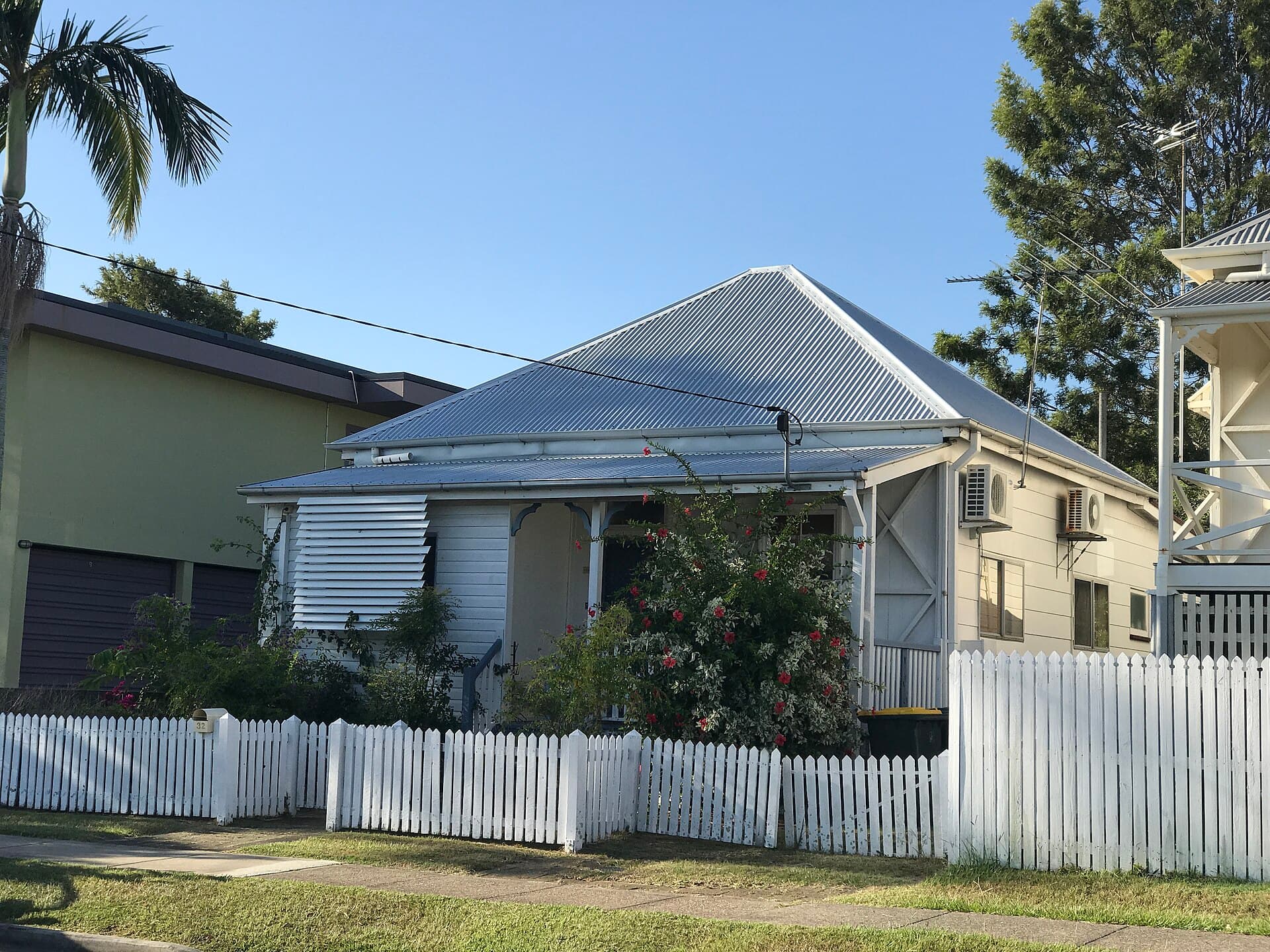
Federation-era house and tiled roof in Clayfield. Photograph: Kgbo. CC BY-SA 4.0. Source: Wikimedia Commons. See the image credits page.
The original Brisbane Roof Restorations site, like a dozen other family pages from the same era, was not written to be charming. It was written to be found by someone whose ridge had split after a January storm. The voice was owner-operator voice: we inspect, we climb, we do not send sales staff, we will put the warranty in writing, we will beat a written quote if the specification is the same. Whether any particular firm always lived up to that sentence is a historical question. The sentence itself described a real division in the South East Queensland trade, and the division has not gone away. It has only become easier to disguise.
A canvasser is not a contractor. A canvasser is a person paid, usually on commission, to convert a letterbox or a knocked door into a signed authority. They are good at weather. They are good at urgency. They are good at standing on a verandah in Clayfield at 5.40 p.m. and explaining that the spray team is “in the area tomorrow” and that the discount will not be. What they are not good at, because it is not their job, is telling you whether the pointing should be flexible, whether the valley iron is already perforated, whether the eaves lining should be sampled, or whether the two-storey drop at the rear needs a rail rather than a story about experience.
The homeowner who has already been sold to once does not need another personality. They need a way to run the conversation so that specification comes before colour.
The owner-operator test, applied without nostalgia
Owner-operator is not a moral costume. It is a description of who holds the licence, who writes the method, and who is available when the first storm tests the ridge. The useful test is documentary, not emotional.
Search the QBCC register — the same register that older quotes called QBSA — for the legal name on the paperwork, not the slogan on the polo shirt. Match the classes to the work. That process is set out in QBCC licensing and what it actually means. Then ask who will be on the roof. Employees whose names the contractor knows are one thing. A labour-hire spray team that changes by the week is another. Subcontracted roof plumbers can be entirely proper, provided they are licensed and named. A shrug is not a subcontract.
Ask whether the person quoting will be the person supervising. On a straightforward low-set concrete-tile roof in Aspley, a trusted leading hand may be enough. On a high-set terracotta Queenslander in Paddington, you want the person who priced the access to see the access. If the quote was written on a tablet by someone who never left the front path, you are buying a photograph.
The old sites also sold driveway high-pressure cleaning as a companion job. That was not a gimmick so much as a recognition that a newly coated roof above a mouldy path looks unfinished. It is still a reasonable extra, and it is still a tell. An owner-operator will look at the driveway and say whether the concrete will mark, whether the water will run into a neighbour’s garden, and whether the same day is even possible. A canvasser will add it as a line item because it sounds like value. Same service, different brain.
Questions that expose a pitch
Take the following list onto the verandah. Write the answers in a notebook, not in the memory of a conversation that will be retold as “they seemed genuine”.
- Which manufacturer and which named membrane system will be used, including primer or sealer if the system requires it? “Industrial grade acrylic” is not a name.
- Will batch numbers be recorded and left with you? A warranty pathway without a batch number is a story.
- Is the pointing a flexible compound suited to subtropical movement, or a cement-rich mix that will hairline? Ask for the product name here too.
- What is in writing after the job — a contractor guarantee, a manufacturer document, both, or a phrase that sounds like one of those things? Read warranties that survive the first storm before you treat any of those words as interchangeable.
- What insurance is held: public liability, and, where the work is eligible, how the statutory home warranty scheme is being handled? Ask to see certificates of currency, not a sentence.
- What is the working-at-heights method on this house? Rails, scaffolding, temporary anchors, harnesses, a second person, a rescue plan. “We’re careful” is not a method.
- How will asbestos-containing material be handled if it appears in eaves, gables or old linings? “Old houses are all like that” is not a method either.
- Who is excluded from the quote: valleys, flashings, solar penetrations, broken tiles above a set number, gutter overflow, fascia? Exclusions are where cheap quotes hide.
If you want those answers in a document you can compare, take them to how to read a roof restoration quote. A quote that cannot survive that reading is not a bargain. It is an incomplete sentence.
What a written guarantee is, and what it is not
The old trade advertised written warranties as a point of honour. Some of them were. Some were a paragraph that dissolved in the first dispute about “existing faults”. A written guarantee from a contractor is only as durable as the contractor. A manufacturer’s warranty is only as durable as the conditions: approved applicator, correct film build, recorded batches, maintenance, and no later trades punching holes without repair. Neither document is a charm against a failed valley that was never replaced.
Do not invent a number in your head and then hunt for a contractor who will say it. Do not accept a spoken “ten years, no worries” as if it were a deed. Ask for the document. Read the maintenance obligations. Read what happens if you sell the house. Read what happens if a solar installer later walks the roof. If the canvasser cannot produce the document and offers to “email it after you sign”, you have learned something about the order of operations they prefer.
Insurance is a parallel confusion. Public liability covers the contractor’s negligence toward third parties and property, within limits and exclusions. It is not a product warranty. The statutory scheme behind licensed residential work, where it applies, is not a coating guarantee either. A contractor who collapses these three ideas into “you’re fully covered” is either careless or hoping you will not separate them.
Occupational health, asbestos and the crew you cannot see
A contractor who will not talk about working at heights will not suddenly become careful when the ladder goes up. Ask about harnesses, temporary anchors and edge protection as if you were asking about primer: they are part of the job cost. On a two-storey Queenslander they may be a large part. If two quotes are thousands apart, the missing money is often the rail and the second person, not a secret supplier.
Ask the same bluntness about asbestos. Most tiles are not the issue. Eaves linings, old fibre-cement, and dust from grinding can be. A crew that proposes to high-pressure clean the whole envelope, including soffits they have not identified, is offering you speed. A crew that will stop and test is offering you a delay that is worth having.
Watch the labour pattern. Owner-operators run small. They book fewer jobs. They resent wet-season overruns because they are the ones who come back. Canvassers run a pipeline. They need this week’s signatures to feed next week’s spray team. If you are being hurried, ask whose diary is full — the roof’s, or the commission sheet’s.
How to end a conversation that has already become a pitch
You are allowed to stop. You are allowed to say that you will not sign on the first visit. You are allowed to ask the person to leave the specification and go. A contractor who is worth hiring will survive a night’s thought. A canvasser whose discount expires at dusk is telling you, quite clearly, that the urgency is theirs.
If they offer to beat any written quote, accept the structure and reject the theatre. A beaten quote is only meaningful when the specification, the access gear, the product system and the exclusions are the same. Otherwise you are watching two different jobs pretend to be a price war. Give them the written specification from the contractor you trust, and see whether they will match that job. Most will match a number and quietly return the exclusions.
The useful contractor talks about your ridge, your moss and your two-storey drop. The useless one talks about your hesitation.
Drive around your own suburb after a storm and look at the roofs that were recoated last spring. Some already show starved ridges, dirty valleys, and coating in the gutters. Some look like roofs. Ask neighbours which visit they had: a person who climbed, or a person who sold. The answers are rarely subtle.
Choosing without a sales pitch is not a personality preference. It is a sequence. Licence, method, product, writing, insurance, heights, asbestos, exclusions. Colour last. Driveway last, if at all. The verandah is your ground. Use it as if the person in front of you will never come back, because the ones who only came to sell never do.
Questions from the verandah
- Why is a canvasser a problem if the work is then done by a licensed crew?
- Because the person who sold the job is paid to close, not to specify. The price, the product and the exclusions are set before anyone who understands pointing or valleys has looked at the roof. You inherit a discount and a vague scope.
- What is the single most useful question on the verandah?
- Who will be on the roof, and which QBCC classes do they hold for the work in the quote? If the person in front of you cannot answer without calling a number they will not show you, you are not talking to the contractor.
- Should I get three quotes?
- Three specifications, not three performances. If two quotes name products, access gear and a written guarantee, and the third is a colour chart and a same-day discount, you do not have three comparable prices.
- Do owner-operators still exist in Brisbane?
- Yes. They are quieter, slower to attend, and less present on social media. They still put a name on the van that matches the register. They are worth waiting for.