Journal home / All articles / Licences and the trade
Working at heights on Brisbane roofs
Fall arrest, temporary anchors and edge protection are not optional extras on a two-storey Queenslander. They are the difference between a restoration and a cheap quote that has already decided whose body will pay for the saving.
Dean Harcourt · 31 March 2025 · Updated 3 August 2026
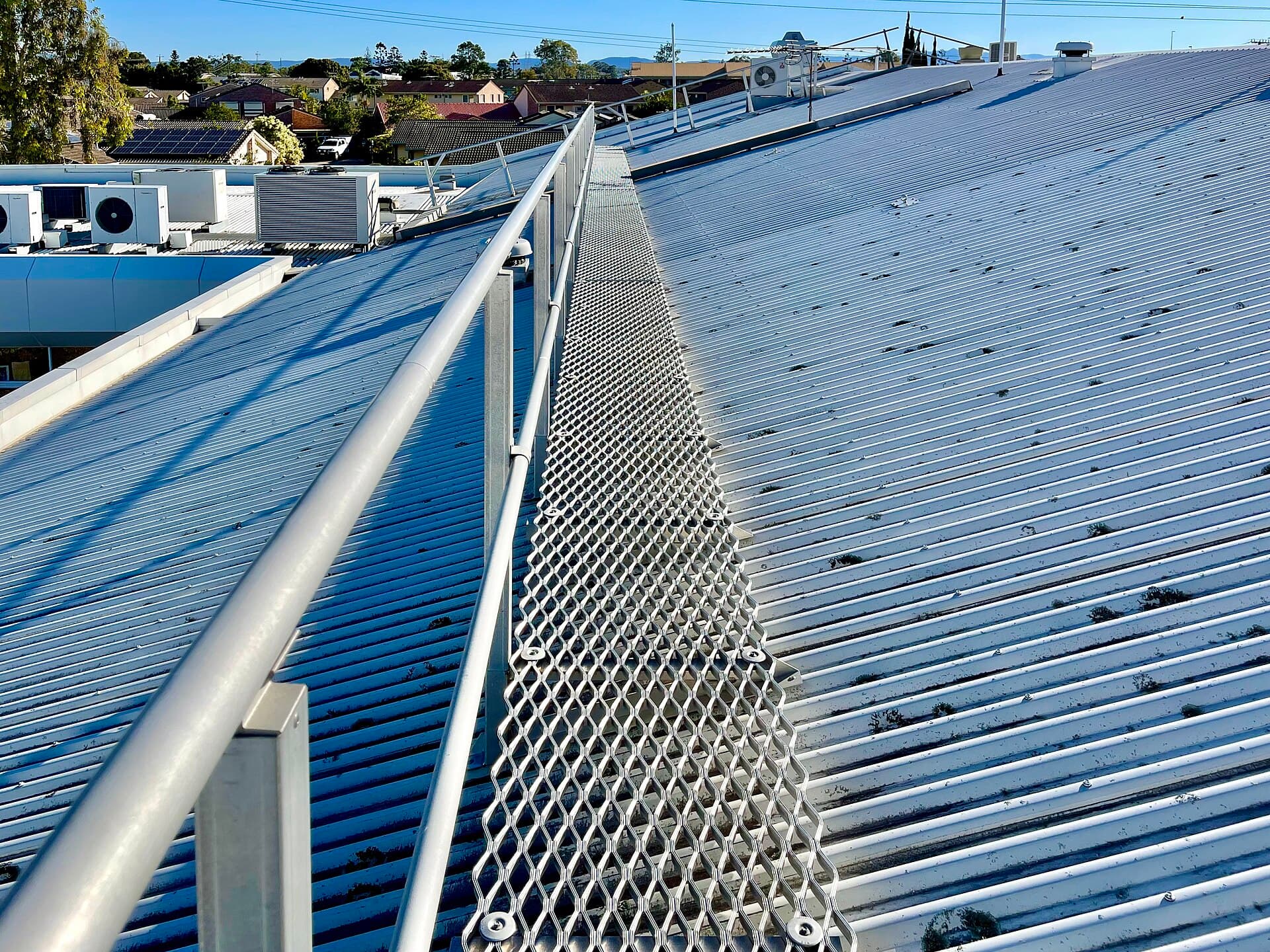
Roof access walkway and fall-protection railing on a Queensland building. Photograph: Kgbo. CC BY-SA 4.0. Source: Wikimedia Commons. See the image credits page.
There is a particular Queensland silence that arrives when a person first steps onto a high-set terracotta roof in Paddington or Red Hill. The street noise drops. The pitch steepens under the foot. The valley iron, if it is original, looks thinner than it did from the lawn. Below the eaves there is a two-metre fall to a verandah roof, and then another drop to timber stairs or a concrete path. People who have never climbed for a living talk about “being careful”. People who have climbed talk about controls, because care is not a system.
Working at heights is the least photogenic part of a roof restoration and the part most likely to be missing from a cheap quote. Membrane colours look handsome on a flyer. A temporary roof rail does not. Neither does a harness, a certified anchor, a spotter, or the hour it takes to set edge protection before anyone lifts a pressure cleaner. South East Queensland’s older housing stock makes the omission worse. High-set Queenslanders, interwar doubles, and the mixed roofs that sit over later extensions were not designed for a spray crew to jog across them in sandshoes.
The regulator’s language is dry, and that is a virtue. Under the Work Health and Safety Act and the managing-the-risk-of-falls code of practice, a person conducting a business or undertaking has to manage fall risk. The hierarchy is not a suggestion. Eliminate the need to be at height if you can. If you cannot, use a work positioning or edge-protection system that stops a person reaching the void. Fall arrest — harnesses, lanyards, anchors — is what you use when those higher controls are not reasonably practicable. Arrest means the person may still fall. The gear is there to stop the fall becoming a death or a broken spine. It also implies a rescue plan, because hanging in a harness after a fall is its own emergency.
A restoration quote that never mentions any of this is not being modest. It is being incomplete.
Why Brisbane roofs are a special case
Geometry is not an aesthetic detail here. It is the hazard. A low-set 1970s brick veneer in Sunnybank Hills, with a moderate concrete-tile pitch and a clear lawn, is a different workplace from a two-storey timber Queenslander in New Farm whose rear addition created a broken ridgeline, three valleys, and a skillion over the kitchen. The second house is the one that fills the emergency-department stories. It is also the house that looks “charming” in a real-estate photograph, which is how homeowners end up surprised.
High-set Queenslanders put the eaves a long way from the ground. Verandah roofs create intermediate surfaces that feel safer than they are: shallow, mossy, often lined with older sheeting, and used as a shortcut to the main pitch. Terracotta on an interwar roof can be brittle. Concrete tiles on a 1980s house can be greasy after a morning dew. Metal roofs in summer are a frying pan. None of these are reasons to avoid restoration. They are reasons to price access properly.
If you want the geometry explained as a restoration problem rather than a safety one, the companion piece is high-set, low-set and complex roof geometry. The short version for this page is simple. The more hips, valleys, dormers and level changes a roof has, the more edges it has, and edges are where people fall.
Two-storey work also changes the public risk. A dropped tile from a Clayfield ridge can kill someone on the footpath. Edge protection and exclusion zones are not only for the person on the roof. They are for the postie, the neighbour’s child, and the owner who “just wants to see how it’s going”. A competent crew will close the driveway, mark the drop zone, and tell you to stay off the verandah until the day’s work is done. A cheap crew will let you wander through with cups of tea.
Temporary anchors, permanent anchors, and the romance of the existing hook
Some commercial and institutional roofs in Queensland have permanent walkways and guard rails. The photograph that sits on this article is that world: a designed access system, inspected, with a rail you can trust. Most suburban restorations are the opposite. There is no walkway. There may be a rusty “anchor” someone screwed into a rafter in 2004 for a television antenna. There may be nothing at all.
Permanent roof anchors are a legitimate control when they have been designed, installed and maintained as anchors. They are not a lucky leftover. A contractor who clips to an unmarked eyebolt because it “looks beefy” is gambling with a human body. Ask whether any existing anchors will be used, whether they have been inspected, and what standard they were installed to. If the answer is vague, they should not be used.
Temporary anchors — weighted, clamped, or installed for the job and removed — are how most one-off restorations have to work. They have to match the roof covering. You cannot treat a terracotta tile like a structural steel deck. You cannot assume a ridge bar will hold a fall. The contractor’s method should say where the temporary points will go, what they attach to, and who is allowed to use them. If the crew is a mix of employees and labour-hire, every person on the pitch needs to be in the same system. A harness in the ute that nobody wears is not a control.
Edge protection sits higher in the hierarchy than a harness, and on many Brisbane jobs it is the more honest expense. Temporary roof rails, scaffolding at the eaves, or a combination of the two stop a person reaching the void in the first place. They also make the work better. Pointing a ridge while fighting a slope with one hand is how ridges get pointed badly. A rail lets the work be work.
What cheap quotes delete
The arithmetic is not mysterious. Scaffolding hire, a two-person minimum, time to install rails, certified temporary anchors, and a supervisor who is not also holding the spray gun all cost money. They also take a morning that does not appear as “restored metres” on a before-and-after photograph. Commission canvassers who need a signature before dusk know this. They sell the colour and the “ten-year look”. They do not sell the rail.
A licensed contractor can still be a reckless one. QBCC licensing and what it actually means is about the legal threshold. Heights are about the method. Ask both. A current roof-tiling class does not tell you whether the nominee supervisor has written a Safe Work Method Statement for your particular two-storey pitch, or photocopied a generic one that mentions “use care”.
Watch for the tells.
- No mention of access, scaffolding, rails or harnesses in the quote or the conversation.
- A single person proposed for a steep or high-set roof, with no ground person and no rescue plan.
- A joke about “not being scared of heights” offered as if fear were the hazard.
- A refusal to pause in the wet. Tiles that are safe enough when dry become skating rinks after a shower, and SEQ afternoons are built out of showers.
- Pressure to start tomorrow because “the spray team is in the area”, which is another way of saying the gear will not be organised for your house.
Owner-operators who still climb tend to be more conservative, not less. They have buried colleagues, or nearly been them. They will talk about the forecast, the moss, the brittle tiles along the north pitch, and the neighbour’s pool fence sitting in the drop zone. That conversation is not nervousness. It is the job.
Asbestos, brittle materials, and the other way a roof can fail underfoot
A fall is not the only way a roof becomes a medical event. Fibre-cement sheeting on older eaves, gable infills and some outbuildings can be asbestos-containing. Some backing materials and old pointing compounds deserve the same caution. A person who steps through a brittle sheet does not need a two-storey drop to be injured. The hole is enough. Grinding or high-pressure work that turns old material into dust adds a hazard that harnesses will not solve.
This is not a reason to treat every 1950s roof as a contamination site. It is a reason to stop and test when the material is unknown, and to refuse any method that treats an old soffit as a handy platform. The restoration sequence in the anatomy of a Brisbane roof restoration should include a moment where the crew looks at what they are standing on, not only at what they are coating.
Driveway high-pressure cleaning, which the old trade sites often sold beside the roof, has its own slip and hose-kick hazards at ground level. It is not working at heights. It is a reminder that the same crew’s attitude to controls tends to be consistent. A team that will not set a rail will also point a pressure lance at a window seal and call it thoroughness.
What a homeowner can usefully ask
You are not the site supervisor. You are the person who chose the contractor. That still gives you a short list of decent questions.
Ask how they will stop a fall at the eaves, not only how they will arrest one. Ask whether scaffolding or temporary rails are included, and where they will sit relative to the verandah and the neighbour’s boundary. Ask who is the supervisor on the day, and whether that person will be on site or on a phone. Ask what happens if the Bureau of Meteorology issues a storm warning at ten o’clock. Ask to see the SWMS, even if you only understand half of it. A document that names your address and your roof type is a different object from a three-page PDF titled “Generic Heights”.
Ask about harnesses last, not first. If the whole plan is a harness, you are looking at the lowest reasonable control being asked to do all the work. Sometimes that is genuinely the practicable option on an awkward pitch. Often it is a way of avoiding the cost of a rail.
If the cheapest quote is cheaper because nobody will be tied off, the discount is being paid in advance by the person on the tiles.
Write the answers down. If a canvasser cannot answer them, end the conversation before you discuss membrane tints. If an owner-operator answers them with a sketch of the eaves and a note about the two-storey drop at the rear, you are, at last, talking to someone who has looked at your house rather than at your letterbox.
Heights work is not heroism. It is a set of dull, expensive, repeatable habits. Brisbane’s roofs will still need those habits in the next wet season, when the same pitches are wet, lichenous and impatient. Pay for the rail. Pay for the second person. Pay for the hour that does not show up in the after photograph. The coating can be redone. A fall cannot.
Questions from the verandah
- Are harnesses legally required on every Brisbane roof job?
- The law requires the risk of a fall to be managed. A harness is one control, not the only one, and it sits below elimination and edge protection in the hierarchy. On many tiled suburban roofs a competent contractor will use a mix of scaffolding, roof rails, catch platforms and fall-arrest gear. A crew that uses nothing, and jokes about it, is not managing the risk.
- Why do some quotes come in so much cheaper?
- Access gear, temporary anchors, a second person on the ground, and time spent installing edge protection are expensive. They are also the first items a canvasser deletes to win the job. The licence may still be current. The method may still be reckless.
- Can I ask to see the working-at-heights plan?
- Yes. Ask for the Safe Work Method Statement, the rescue plan, and a plain description of what will sit at the eaves. If the answer is “we’ve been doing this twenty years, she’ll be right”, you have your answer.
- Do permanent roof anchors solve the problem for a one-off restoration?
- Only if they exist, are certified, are in the right places, and are compatible with the crew’s gear. Most Brisbane houses have none. Temporary anchors and other controls have to be designed for that visit, then removed or left only if they are a proper installation.