Journal home / All articles / Climate and weather
Moss, lichen and mould in humid Queensland
Green on a Brisbane roof is not a colour choice. It is a living film that holds water, lifts pointing and tells you which pitches never see a decent afternoon of sun.
Patrick O'Shea · 28 March 2025 · Updated 21 June 2026
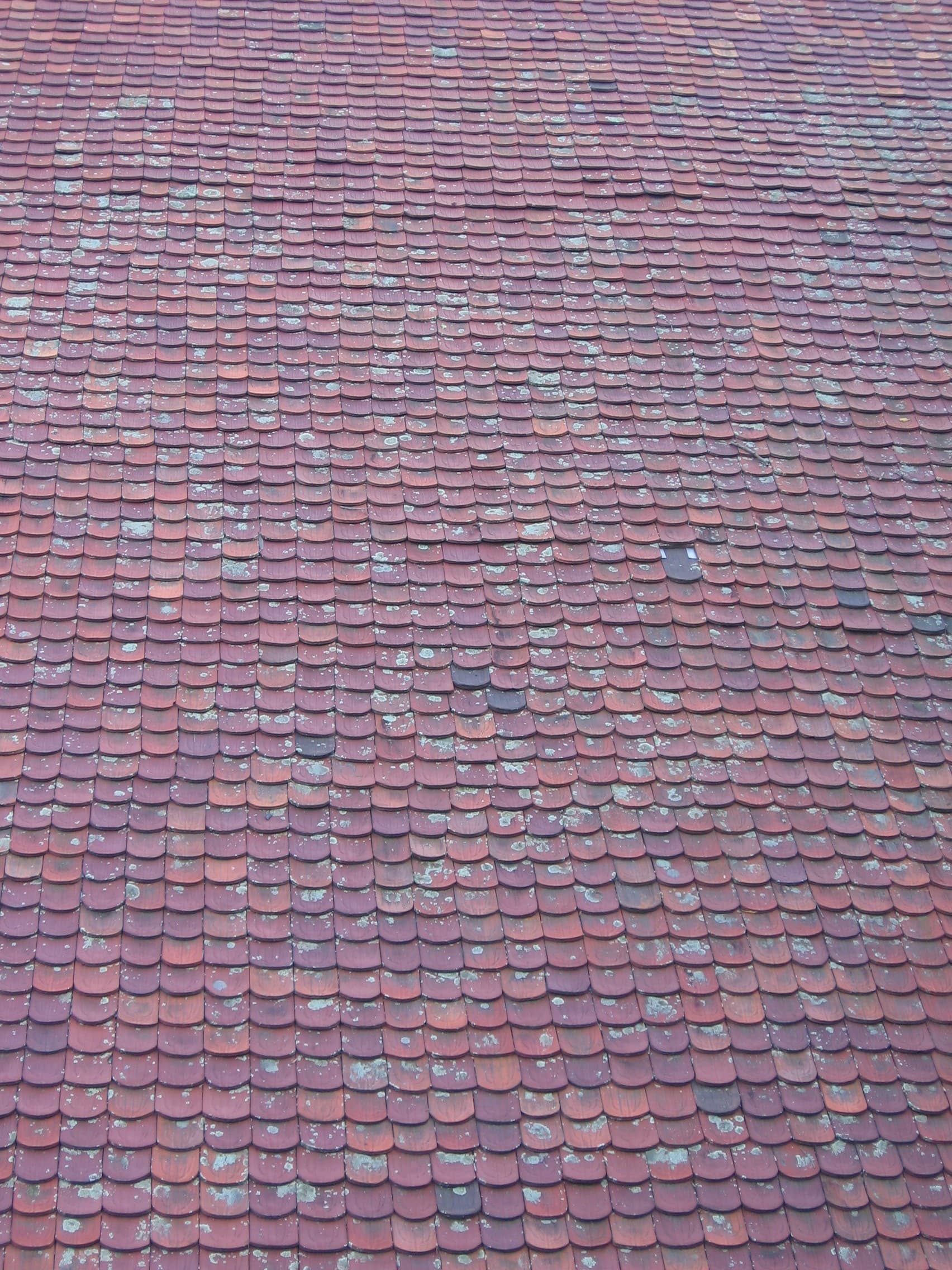
Close view of weathered concrete roof tiles. Photograph: PookieFugglestein. CC0. Source: Wikimedia Commons. See the image credits page.
Walk any street in St Lucia, Bardon or Chelmer after a wet week and you can map the light without a compass. The northern pitches are merely dirty. The southern pitches are green. Sometimes the green is a soft plush of moss in the pans. Sometimes it is the grey-green scab of lichen on the crowns. In the ceiling space, if you are unlucky, there is a third relative: mould on sarking and timber that has been living on the same humidity the garden enjoys.
People call this a look. Real estate photography treats it as a filter to avoid. The trade treats it, too often, as a reason to sell a blast and a paint. The honest account is slower. In humid Queensland, biology on a roof is a water-holding system. It changes how the tile dries, how the pointing fails, and how long a membrane can pretend to be a surface rather than a lid over a sponge.
This essay is about that biology, the shade that feeds it, and the difference between killing a film and attacking a tile. It sits beside the practical work of pressure-cleaning tile roofs without breaking them and the year-round habits in a seasonal maintenance calendar for SEQ roofs. The suburbs will keep growing trees. The roofs will keep facing south. The question is whether we treat the green as dirt or as climate.
A roof as a habitat
Concrete tiles are porous enough, once the factory face has gone, to hold dust, pollen and the fine grit of their own ageing. That grit, wetted daily by dew and irregularly by storms, is soil enough. Moss does not need a forest. It needs a film of water and time. Lichen is even more patient. It is a partnership of fungus and alga that etches what it sits on. Mould, indoors and in the roof space, is the one that worries health and timber. They are not the same organism and they do not yield to the same afternoon of work, but they share a climate: humidity that does not leave.
Brisbane’s humidity is not a statistic on a tourist brochure. It is the reason a towel does not dry on a rail in February and the reason a southern pitch in Indooroopilly is still damp at eleven in the morning. The wet season loads the system. The dry season does not unload it completely, because nights are still mild and the dew point is often close to the morning air. A Melbourne roof can bake sterile. A Brisbane roof, under the right tree, never quite does.
Shade decides the map. Jacarandas are the local specialty — a purple week in spring and a grey shade for the rest of the year, plus a litter of seed pods that sit in gutters like a second crop. Figs, camphors, and the generous eucalypts of the western suburbs do the same work without the postcard. A two-storey extension next door, a new apartment in West End, a high-set’s own upper verandah: all of them draw a line across a pitch and say, here the sun does not get to finish the job.
North-facing pitches in this city can still grow lichen if they are low-pitched and filthy, but the classic failure is south and south-east, especially on concrete tile roofs across Brisbane suburbs laid in the 1970s and 1980s, when the estates went up faster than the trees and the trees have since won.
Why green is not cosmetic
Moss holds water. That is its talent. After a night of dew, a clean tile will dry from the crown down as soon as the sun or the breeze arrives. A mossy pan stays wet. The wetness works into the body of an already tired concrete tile. Freeze-thaw is not our problem — we do not get that gift — but wet-dry cycling is, and so is the simple weight of a pitch that never drains in the small sense.
Lichen is slower and ruder. It grips. When someone later scrapes or blasts it, the face of the tile can come away with the organism. What remains is a fresher, more porous surface, eager for the next spore. This is why a roof that has been “cleaned hard” can look briefly new and then green again sooner than the neighbour’s, which was only treated and left to release.
Pointing suffers. A ridge joint that is already hairline-cracked becomes a planter. Moss in a joint is a wedge that stays wet and keeps the crack open. The first leak after a storm is blamed on the cell. The cell only used a path that biology had been preparing through winter.
There is a structural courtesy, too. Wet tiles are heavier. Wet sarking stays wet. Timber battens in a poorly ventilated roof space pick up the same climate. None of this means a green roof is about to collapse. It means the envelope is running a different water budget than the one the original tiler assumed when the street was still bare and the jacarandas were whips.
Mould in the house is the part that stops being a roof story. Condensation, bathroom exhausts dumped into the ceiling, and storm leaks can all feed it. A green roof is not a diagnosis of indoor mould. It is a clue that the upper surface is staying wet, and that the roof space may be sharing that habit. If you can smell the ceiling, you are no longer in the territory of a weekend bleach.
Biocide first, blast later — if at all
The trade inherited a muscle memory from the years when a restoration was a blast, a coat of something acrylic, and a handshake. That memory is hard on tiles. High pressure on old concrete, especially at a close distance or with a narrow tip, will stripe the face, snap corners, and drive water under laps into the house you were hired not to wet. Terracotta is less forgiving again.
A more civil sequence exists, and it is slower, which is why it loses the sales race.
Treat first. A biocide labelled for roof and masonry use, applied to a dry-enough surface, given the hours or days it asks for, will kill the film. Dead moss lets go more kindly. Dead lichen lets go more kindly than live lichen. The roof will look worse before it looks better. That is not failure. That is the organism letting go of the tile.
Then clean with the least force that works. Sometimes that is a controlled pressure wash at a sensible distance, with the fan wide and the operator walking with the fall, not against it. Sometimes it is a softer wash and a lot of rinsing. The test is the tile, not the machine’s maximum bar. If a tile rings wrong or a corner moves, you have found the limit.
Collect what comes off. Gutters will fill with a green-black porridge. Downpipes will deliver it to rainwater tanks if you let them. People who drink their roof should know that a clean is a contamination event. Disconnect, flush, and do not treat tank water as a spectator sport.
Do not confuse a biocide with a coating. Killing the film does not waterproof the tile. It prepares a surface. If the later job is a membrane, the surface needs to be clean, dry and sound — three adjectives that are cheap to write and expensive to wait for in February.
Household shortcuts have a literature of regret. Pool chlorine on a roof will kill more than moss and will find the nearest ornamental plant, the nearest coloured fascia, and the nearest apology. Sugar soap and a stepladder will not reach the ridge and will put you where the moss is most slick. If the pitch is steep or the tiles are glazed with wet growth, the correct tool is a licensed person with fall protection, not optimism.
Shade, trees and the argument with the garden
A restoration that ignores the tree is a subscription. You can coat a southern pitch in Taringa to a handsome grey and, within a few wet seasons, watch the same map of shade draw the same map of green through whatever pinholes the coating allows. The coating may still be doing weather work. It will not win against a fig that waters the tiles every night with drip from its own leaves.
This is not an argument for cutting every jacaranda in Brisbane. It is an argument for treating canopy as part of the roof specification. Lift the skirt of a tree that dumps on a valley. Clean gutters on a rhythm that matches the litter, not a national slogan about “once a year”. If a neighbour’s tree is the climate of your southern pitch, that is a conversation, and sometimes a council one, and it will take longer than a coating.
New work can make shade worse. A solar array that covers a pitch also covers the drying. The tiles under the panels become a habitat the hose cannot honestly reach. Designers who leave a service gap and owners who book a clean that includes the array are both rarer than they should be. The green you cannot see from the street is still holding water.
Streetscape matters in the older suburbs. A bare roof under a butchered tree is a kind of violence the neighbourhood will remember. The better restorations I have watched kept the tree and changed the maintenance, or pruned with a reason that could be explained from the footpath. The worse ones treated the garden as an obstacle to a spray schedule.
Living with a climate that wants a film
You will not sterilise a Brisbane roof. You can only decide how wet you will let it stay, and how much of the organism you will remove before it becomes a wedge.
A few habits earn their keep:
- Look at the southern pitch after two dry days in winter. If it is still dark and soft, you have a drying problem, not a colour problem.
- After the first big jacaranda drop, treat the gutters as a roof component, not a chore you will get to.
- If you last cleaned with high pressure and the green returned in a rush, do not buy a stronger machine. Buy a slower chemistry and a gentler rinse.
- In the ceiling space, look for staining that follows the mossy pitch, not only the valleys. Biology and storm water can share a path.
- If indoor mould is in the bedrooms rather than the bathroom, stop guessing and get the leak and the ventilation looked at as two systems.
The roof is a habitat because the climate is a habitat. Shade, dew, and the long wet season are not going to retire.
The literary temptation is to call the green picturesque. Queenslanders with a furred southern hip have a certain melancholy in late light, and photographers know it. The practical temptation is to call it filthy and blast it into the downpipe. The adult position is in between.
What you can retire is the idea that a single afternoon of force is the same as care. Kill the film. Clean with manners. Keep the tree if you can, and the drying if you can, and the pointing out of the planter business. The next storm will still come in from the south-west and test every joint. It should not also have to test a pitch that has been wet since June.
Questions from the verandah
- Is a green roof only a cosmetic problem?
- No. Moss and lichen hold water against the tile, keep the surface wet after rain, and can lift pointing and force laps apart. The leak often arrives later, looking like a storm problem, when the long problem was shade and biology.
- Should I pressure-blast moss off tiles myself?
- Prefer a biocide and time, then a controlled clean by someone who understands tile strength. Uncontrolled blasting drives water under laps, snaps brittle tiles and etches the face so the next colonisation is faster.
- Why is the south side always worse?
- In this hemisphere the southern pitch gets less sun. Add a jacaranda, a neighbouring two-storey, or a high-set’s own shadow, and the dew sits until late morning. That is enough of a climate for moss to treat the tile as soil.