Journal home / All articles / Climate and weather
Heat, UV and cool-roof coatings
Brisbane roofs fail in the sun as well as the storm. Solar absorptance, attic heat and the new pale tints are a materials problem, not a colour-chart romance.
Asha Varghese · 14 April 2025 · Updated 8 August 2026
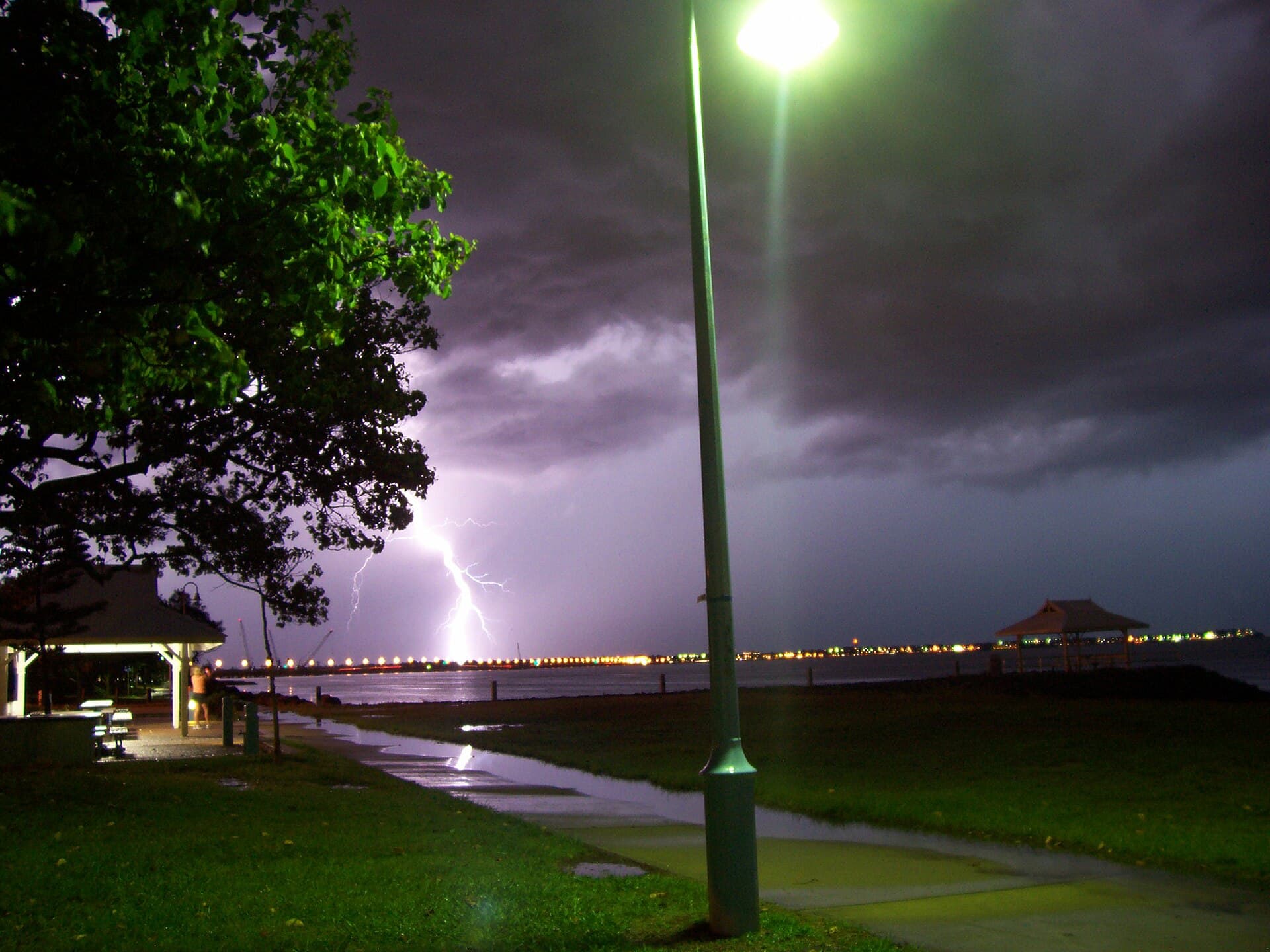
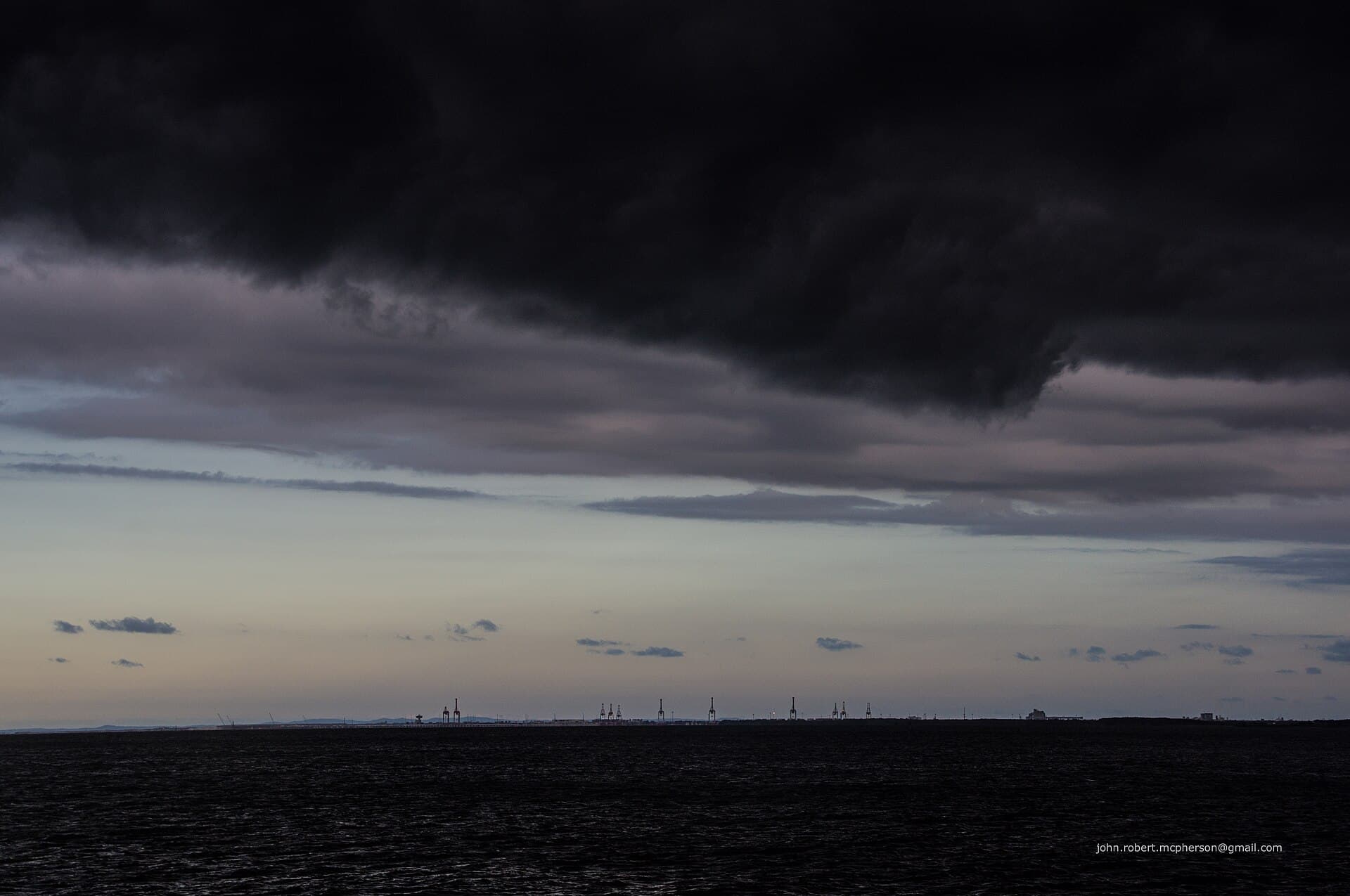
Storm light over Moreton Bay between Brighton and Redcliffe. Photograph: zpunout. CC BY-SA 3.0. Source: Wikimedia Commons. See the image credits page.
By ten o’clock on a clear February morning, a western pitch in Graceville is already a different climate from the garden. The tile or the steel has taken the UV that the verandah has only sampled. The roof space above a 1970s brick veneer in Carindale is heading toward a temperature you would not ask a dog to sit in. The storm, if it comes, will be the afternoon’s drama. The heat is the day’s actual work.
Brisbane’s sun is not an accessory to the wet season. It is a second weather. Ultraviolet light cooks binders. Infrared heats masses. The combination ages pointing, fades factory finishes, and turns a dark roof into a radiator that points at the ceiling. Cool-roof coatings — pale colours, and the newer tints that look mid-range but reflect more of the invisible heat — are one response. They are not a religion, and they are not a substitute for a roof that is still a roof.
This is a materials essay, not a colour-card. It sits with the chemistry of membrane coatings, primer, sealer and topcoats and with the quieter duties of the first twelve months after restoration. Metal has its own afterlife in Colorbond and corrugated metal restoration. What follows is the heat that all of those surfaces share.
The roof as a collector
Solar absorptance is an unlovely phrase for a simple idea: how much of the sun’s energy a surface keeps. A white or very light surface keeps less. A charcoal keeps more. The number lives on product data sheets as a decimal or a percentage and is more useful than the word “cool” on a brochure. Two greys that look similar on a fence sample can disagree in the infrared. That disagreement is the whole point of the specialised pigments that have been sold, in this country, under names such as InfraCOOL and its cousins.
I am not here to pitch a brand. The class of product is what matters. Conventional pigments absorb a lot of near-infrared even when the visible colour is not black. “Cool” pigments are chosen to bounce more of that band. The roof can therefore be a respectable mid grey from the street — the colour many body corporates and heritage streets will actually permit — and still run cooler than a conventional grey of the same apparent depth.
How much cooler depends on the rest of the house. A high-set Queenslander in Corinda with generous eaves, a ventilated subfloor and a roof space that actually breathes is already doing part of the work. A low-set with boxed eaves, foil that was torn by the last electrician, and R-values from a decade that thought insulation was optional will hand the roof’s heat straight to the plaster. Coating the lid of that house a paler tint will help. It will not make it a different house.
Attic heat is the number people feel. Roof-surface temperature is the number the coating feels. Both matter. A surface that regularly sits in the sixties or worse is asking a lot of an acrylic membrane, of the thermal movement in a concrete tile, and of the sealants around solar penetrations. UV does the chemical half of the same job: it breaks the binder, chalks the film, and leaves the pigment as a dust that then washes into the gutter. Heat and UV are not two seasons. They are two hands on the same object.
What a cool coating can and cannot do
A well-applied, more reflective membrane can:
- Lower the surface temperature of tile or prepared metal on the sunward pitches.
- Reduce the peak temperature in a roof space that has nowhere else to send the heat.
- Slow some of the thermal cycling that opens tired pointing and tired laps.
- Make upstairs rooms less punishing in the hours before the sea breeze or the storm arrives.
It cannot:
- Repair a rusted valley or a cracked tile.
- Replace bulk insulation, or fix foil that is serving as a dusty hammock.
- Stop wind-driven rain.
- Make a dark streetscape covenant disappear.
- Turn a roof at the end of its structural life into a candidate for another decade.
Those limits are why cool coatings get oversold on the verandah and undersold in the specification. The honest pitch is modest and physical. You are changing absorptance and, if the system is a proper membrane build-up, you are also sealing a porous tile face. You are not buying a new climate.
On metal, the conversation overlaps with factory finishes. Colorbond already is a designed solar surface, with colours that have published absorptance and, in the cooler range, their own infrared-reflective story. Restoring a faded steel roof with a generic dark membrane can move the number the wrong way. If the steel is sound and the fade is the complaint, a system chosen for metal, and a colour chosen for heat, is a different job from painting a tile roof charcoal because the owner liked a fence.
Colour, streetscape and the politics of pale
Brisbane is not a city of whitewashed roofs, and it should not pretend to be Santorini because a data sheet likes a low absorptance. The older suburbs have a palette: terracotta and weathered concrete, galvanised silver going to grey, the deep oxide reds of some Queenslanders, the pale greens and creams that seemed modern in 1988. A sudden field of bright white on a hip roof in Hamilton will cool the attic and start a conversation with the neighbours that is not about physics.
Cool pigments exist partly to solve that politics. A mid grey, a sand, a muted green that reflects more infrared than it appears to can be the compromise between a heat-sensible roof and a street that still looks like itself. Body corporates, which collect opinions the way gutters collect leaves, should ask for absorptance numbers rather than adjectives. “Too white” and “too hot” are both real objections. They are not the same objection.
Heritage overlays and character streets complicate the chart further. A restoration in Paddington or New Farm that changes a weathered terracotta look to a stark cool white may be physically clever and socially clumsy. There are tints that keep the suggestion of clay and still do some infrared work. There are also roofs that should stay uncoated because the terracotta is the point, and the heat should be handled with insulation, shading and the trees the street already owns.
Western pitches earn the most from a reflective change. In a city where the afternoon sun is a specialist, the western hip of a house in Sherwood or the western run of a long ranch in Capalaba is where the plaster upstairs learns about absorptance. If budget forces a choice, that is the pitch to treat as a heat surface, not only as a rain surface.
UV, chalking and the life of a film
Even a clever pigment lives in a binder, and the binder lives in this sun. Films chalk. The quality of the acrylic, the thickness of the build, the primer underneath and the honesty of the dry-film thickness all decide whether the chalking is a slow, expected ageing or a powder in year three.
UV is also why dark colours, conventional or cool, ask more of the system. They run hotter, so the film is chemically and physically busier. A charcoal roof in Redcliffe can look handsome against the bay and still be the colour that shortens the maintenance interval. That is a legitimate aesthetic choice if it is made with the interval in mind. It is a poor surprise if the owner thought “coated” meant “finished”.
Chalking washes. It ends up in gutters and, if you drink the roof, in the tank. A cool coating does not exempt you from that housekeeping. The first year after a restoration is when you learn whether the film is shedding as designed or failing as a shortcut. Walk the downpipes after the first serious summer storms. Look at the pale fan on the path. A little dust is a film living in Queensland. A lot of colour in the gutter is a film leaving.
Solar arrays complicate the UV story in a smaller way: they shade stripes and leave the rest to cook, so the film ages in bands. The next recoating will show those bands as a ghost. Designers who leave access and owners who accept that a roof with panels is a roof with two climates are both being accurate.
Choosing heat as a specification, not a mood
If you are writing or reading a restoration specification in this climate, heat deserves its own lines, not a sentence at the end about “modern cool tones”.
Ask for:
- The proposed colour and its solar absorptance, not only its name on a fan deck.
- Whether the pigment technology is conventional or infrared-reflective, in plain language.
- The system build — primer, sealer, topcoats — and the dry-film thickness the applicator will actually check.
- How the colour sits with any overlay, covenant or body-corporate palette.
- What the roof space already has in insulation and ventilation, so the coating is not being asked to atone for an empty attic.
Then look at the house as a hot-weather machine. Eaves, trees, blinds, the western wall, the habit of the afternoon north-easterly off Moreton Bay — these are the rest of the specification. A pale hip in Brighton will still be a hip in a humid, bright, storm-fed city. It will just argue less with the sun while it waits for the shelf cloud.
The sun does not invoice. It simply remains, day after day, on the same western tiles, until the binder gives up and the rooms upstairs learn the colour of the roof by heart.
There is a temptation, after a brutal January, to treat cool coatings as a moral good. They are a tool. Used on a sound roof, with a colour the street can live with and a system that can survive UV, they take some heat out of a climate that has plenty to spare. Used as a story to sell a spray on a roof that needs valleys, pointing or replacement, they are just another way of talking about paint while the sun continues its quieter, more thorough storm.
Questions from the verandah
- Will a cool-roof coating replace insulation and ventilation?
- No. A more reflective roof surface can lower roof-space temperatures, but it does not do the work of bulk insulation, a radiant barrier used properly, or airflow through the eaves and ridge. Treat it as one layer in a hot climate, not a miracle lid.
- Are very dark roof colours a bad idea in Brisbane?
- They absorb more of the sun and run hotter, which is harder on the coating, the tile or steel, and the rooms below. They are not forbidden. They are a heat choice as well as a streetscape choice, and should be priced that way in comfort, not only in taste.
- Is InfraCOOL a brand I have to buy?
- Treat that family of tints as a class — pigments designed to reflect more near-infrared than their visible colour suggests. Several systems exist. Specify the solar absorptance you want and the membrane system you trust, not a slogan on a flyer.