Journal home / All articles / The restoration process
Membrane coatings: primer, sealer and two topcoats
A roof membrane is a film with a thickness, a weather window and a batch number. Thin paint on a Brisbane tile is a colour. The old trade specified a sealer and two heavy acrylic coats because the climate does not respect a stain.
Asha Varghese · 8 May 2025 · Updated 11 August 2026
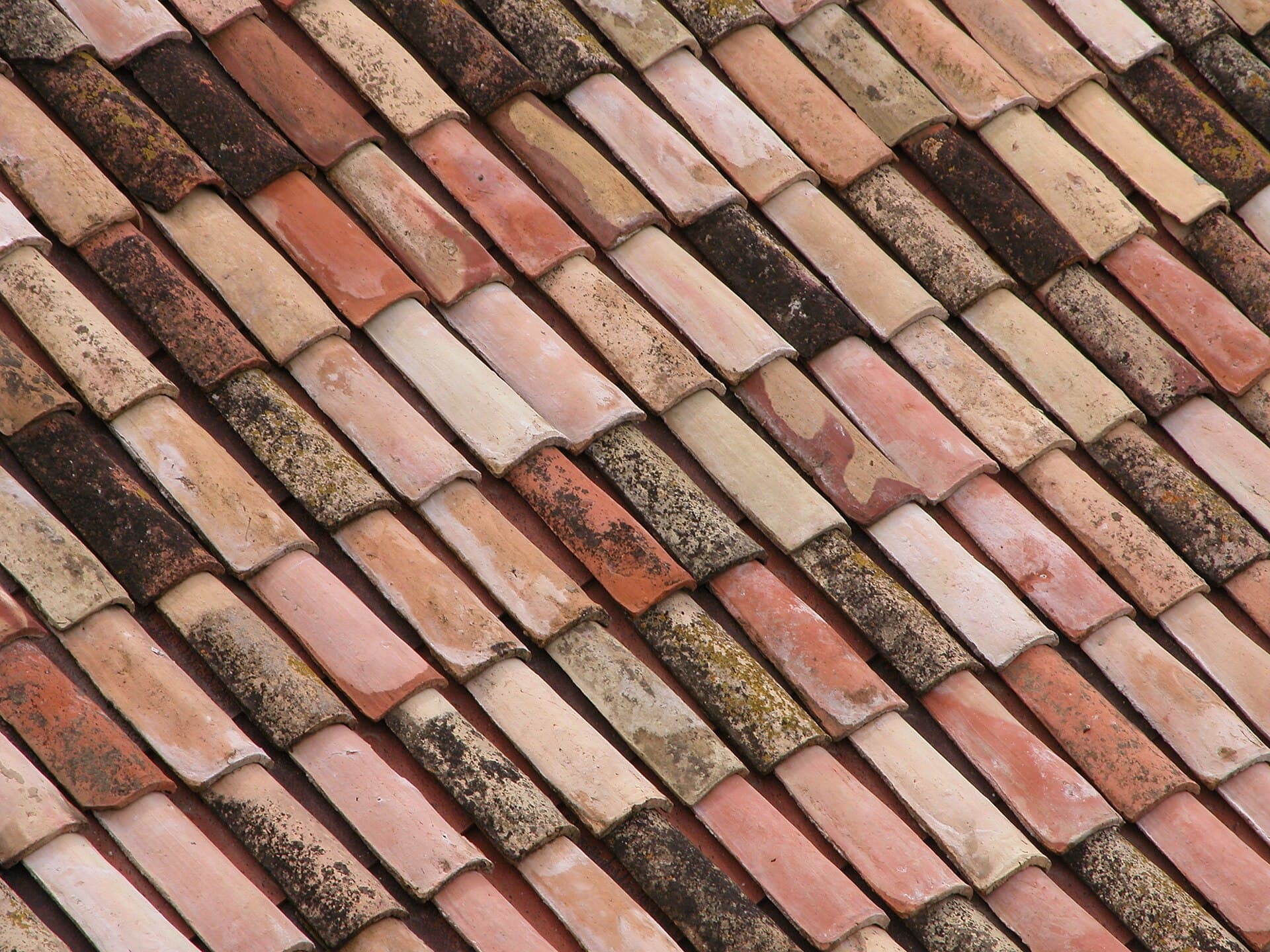
Monk-and-nun terracotta tiles in close detail. Photograph: Procsilas Moscas. CC BY 2.0. Source: Wikimedia Commons. See the image credits page.
The last photograph in a restoration brochure is always the same. A roof that has become a single colour, edges crisp, lichen gone, the house suddenly younger from the street. What the photograph cannot show is whether that colour is a film or a stain. In Brisbane the distinction is not academic. A stain weathers off. A film, if it was built to a thickness and applied in a window the data sheet would recognise, is the part of the restoration that meets the next ten summers.
This journal does not sell coatings. It describes what the old trade actually specified: a sealer or primer on a clean tile, then two coats of a heavy acrylic membrane, historically in the family of systems people still shorthand as Dulux AcraTex and its cousins. Naming a historical system is not an endorsement. It is a way of saying that a roof finish was understood to be a system, with a sequence and a thickness, not a leftover drum from a wall.
The anatomy of the job puts the membrane last for a reason. Everything before it — tiles, valleys, ridges, the wash — is about whether the film has a roof to sit on. This essay is about the film.
Acrylic membranes and the thin paint that impersonates them
A roof membrane, in the sense used on concrete and terracotta tiles across South East Queensland, is a flexible acrylic designed to build a dry film. It is meant to follow small movement, bridge hairline cracks for a time, and remain a sheet rather than a chalk. Roof paint, as the phrase gets used on a verandah in Aspley, often means whatever was cheap, tinted dark, and put through a sprayer until the tile changed colour.
Both can look identical at handover. Six months later the difference is in the valleys and the south pitch, where UV and moisture do their slow work. Thin films go to chalk. They pull off at the edges of a pointing joint. They leave the tile face as exposed as it was, only greyer. A built film stays a film longer. It still weathers. It is not immortal. It is simply doing the job it was specified for.
Flexibility matters because a Brisbane roof is not a slab. Tiles heat and cool. Timber under them moves. A brittle coating on a concrete tile in Sunnybank Hills will map-crack. A more flexible membrane can live with that movement if the thickness is there and the substrate was sound. No membrane, however advertised, will hold a ridge that has already walked, or a valley that is rust lace. Those are other essays.
Water-based acrylics dominate the local trade because they can be applied with the equipment crews already own, they clean up without a solvent story, and they suit a climate where you may have a morning window and a two o'clock shower. Solvent systems exist. They are not the vernacular of a Brisbane tile restoration, and a homeowner being talked into one should ask why.
Dry-film thickness, or why one heavy coat is not two
Manufacturers specify coats because porous tiles steal binder. A concrete tile in Geebung or Regents Park will drink the first pass. If that pass was meant to be your only topcoat, the surface looks covered and the film is a rumour. A sealer or primer is there to wet the tile, bind the dust the wash left, and give the topcoats something to sit on. The two topcoats then build thickness.
Dry-film thickness — the film after water has left — is the measurement that makes a specification real. Wet-film gauges exist. So do theoretical spreads based on litres per square metre. A crew that can tell you the target, and that works to a spread rate instead of a finish-from-the-street, is working as if the film mattered. A crew that sprays until the roof is the right colour and the drum is empty is working as if the photograph mattered.
Reciprocating over a hip to hide a thin patch is not the same as a second coat. Second coats need a recoat window: dry enough to take the next pass, not so cured that the new film will not key, and not so late in the day that dew will sit on a tacky surface. Brisbane afternoons in March will test that window without warning.
A roof that is the right colour from the street and the wrong thickness in the valley is not finished. It is photographed.
Under-application is the common sin. Over-application has its own: sags in a valley, a film so thick it skins and stays wet underneath, a texture that holds dirt. The data sheet is not poetry. It is the bit of the job that does not care about your diary.
Cool-roof tints and the Brisbane heat
Heat, UV and cool-roof coatings are a climate subject as much as a product one. Here the practical point is colour. A light, more reflective tint can lower the temperature of a tile surface in a January sun. That can take a little misery out of an upstairs room in a low-set in Karalee, and a little load off an ageing ceiling space. A very dark charcoal, which photographs well against pale walls in New Farm, will run hotter. The membrane may still be sound. The house will not feel as though you did it a favour.
Cool-roof talk is sometimes sold as a substitute for insulation, ventilation or a decent ceiling. It is not. It is a surface choice with a thermal consequence. If you are already coating, choosing a lighter tint is one of the cheaper climate decisions you will make. If you are choosing a dark tint because the street has decided that every roof should look like a new car, know what you are buying.
Pigment quality matters for fade. Cheap tints chalk and go patchy on the north and west pitches first. You will see it on a concrete roof in Cleveland earlier than you wanted. The film may still be there. The colour you paid to look at will not.
Batch numbers, leftover drums and the story of a system
Products, batch numbers and manufacturer warranties deserve their own ledger. The short version for a coating day is this: a system is a set of named products, applied in order, from identifiable batches. If a manufacturer ever stands behind a film, they will want that story. Unlabelled drums, a primer from one brand and a topcoat from another, a leftover grey from last month's job in Birkdale tinted on site to approximate charcoal — those are colours. They may perform. They are not a system you can describe in a letter.
Write the batch numbers down. Keep the data sheets. Note the date, the weather, and which pitches were done in which window. This is dull. It is also the only evidence you will have if the film fails in a way that looks like product rather than workmanship. Brisbane humidity makes that distinction argumentative enough without losing the paperwork.
Historically, crews talked about being applicators for a named membrane range. Some were. Some used the name as a vibe. The name on a flyer is not a batch number on a drum. Ask to see the drum. It is an impolite and useful question.
Dew, humidity and the window you cannot buy
A coating applied to a tile that is still cool and wet from overnight dew will not be the coating on the sheet. It will blush, go milky, or fail to key. A coating applied in a still, humid afternoon may skin and trap moisture. A coating applied as a southerly change arrives may take rain before it can. None of these are character flaws in the acrylic. They are weather.
Brisbane's useful coating windows are often mid-morning to early afternoon in the drier months, and shorter than that when the wet season is thinking about it. Shade from a large tree in Chelmer can keep a western pitch damp until lunch. A high-set in Corinda may have a dew that lingers on the south plane after the north is ready. A crew that starts the whole roof at eight because the van was booked at eight will coat at least one pitch too soon.
Wind is a colleague and a vandal. It dries. It also takes overspray to a neighbour's car in Clayfield and dries a wet edge so fast that the next pass leaves a lap mark. Spray technique is a trade skill. So is knowing when to stop and wait for a day the sheet would recognise.
Rain after a coat is the letter everyone writes. Sometimes the film has skinned enough to cope. Sometimes it has not. The honest response is to look, not to hope from the driveway. A washed-off coat is a recoat, not a debate about whether the drops were heavy.
How the system sits on different tiles
Concrete tiles, porous and faded, are the membrane's natural habitat in this city. They want sealer. They want two coats. They will show a thin film as a stain within a couple of summers. They are also the tiles on which a cool-roof tint does the most obvious thermal work, because there is so much of them, on so many dark, heat-soaked estates.
Terracotta is more complicated. Some terracotta should not be coated at all — glazed, sound, heritage, a surface whose character is the point of the house. Some unglazed, porous, leaking terracotta has already been coated twice and will be coated again because the alternative is a replacement the owner cannot face. A membrane on terracotta must still be a system. It must also be a decision, not a default. This journal takes that argument up with the terracotta essay. Here it is enough to say that a sealer designed for concrete may not be the sealer a terracotta body wants, and that a heavy film can change the way an old tile handles moisture.
Metal is not this essay. Acrylics on rusty corrugated iron are a different chemistry and a different honesty. If a quote treats tiles and tin as the same spray day, the quote is a colour chart.
What a coating day should look like
The roof is repaired and clean. The ridges are pointed and ready. The tiles are dry to the touch and, more importantly, dry in the body — concrete that still feels cool and dark is not dry. The forecast is not a performance. It is a constraint.
- Mask glass, solar, eaves and anything a tinted mist will ruin.
- Stir and strain as the sheet says. Do not shake a membrane like a cocktail.
- Seal or prime at the specified spread. Do not starve the tile to save a drum.
- Recoat inside the window. Two topcoats, not one heavy pass with a story.
- Keep wet edges alive. Do not leave a dry lap across a visible pitch.
- Record batches, times and weather. Dull, and the only archive you will have.
On a modest low-set in Aspley this can be a day. On a broken-plan roof in Greenslopes with hips, valleys and a solar paddock, it is two days and a refusal to coat the last pitch in the wrong light. The old “two to three days, weather permitting” included this refusal. The jobs that arrive at this desk as complaints are the ones that treated “permitting” as optional.
After the film, before the myth
A new membrane is not a new roof. It will not stop a leak whose path is a failed flashing or a cracked tile you did not replace. It will not make a rotten batten sound. It will, if it is thick enough and lucky in its weather, give a sound tile roof another stretch of life in a climate that is trying to grow a garden on it.
Look after the gutters. Do not send a satellite installer across a fresh film in hard shoes. Do not assume a dark patch after the first storm is the coating failing — it may be a valley you should have replaced. And do not let anyone tell you that a single thin pass, done on a damp Tuesday because the week got away, is the same system the old trade meant when they said sealer and two coats.
The photograph will still look finished. The climate cannot read a photograph. It can only test a film.
Questions from the verandah
- What is the difference between a roof membrane and roof paint?
- A membrane is specified to build a flexible dry film that can move with the tile and shed water. Paint, in the thin sense, is a colour layer that may look the same from the street and fail at the first crack.
- Why are there three coats on a competent job?
- Porous concrete drinks the first coat, so a sealer or primer has to wet the tile. Two topcoats then build the film. One heavy spray is a hope, not a thickness.
- Do cool-roof tints actually help in Brisbane?
- Lighter, more reflective colours can drop roof-surface temperature and take some load off a hot ceiling space. They will not rescue a roof that still leaks, and a very dark tint will undo most of the benefit.
- Why do batch numbers matter?
- Because a warranty, if a manufacturer ever stands behind one, is a story about a specific product on a specific day. Unlabelled drums and mixed leftovers are a colour, not a system.